The $500 Billion Mirage_ Why Thinking Smaller is the Secret to Winning Big in the Abilene Data Center Boom
The Abilene Concrete Pivot:
Bridging the $500B Stargate Gap
⚠️ About This Case Study
These case studies are composite illustrations. The individuals featured are fictional and do not represent a real client. However, the market data, local opportunity, competitive landscape, pricing, and regulatory details referenced are based on real research for this trade and location. Results shown are illustrative of what the data suggests is possible — not a guarantee, promise, or projection of income. Your outcome depends on your effort, skill, capital, timing, and market conditions. Bypass Capital does not provide financial, legal, or tax advice. Always do your own due diligence and consult a qualified professional before starting or investing in any business.
Here is the Deep Dive Podcast for Travis - Surviving the Abilene Stargate Concrete Boom
Below you can see what Travis's V-Scan looks like — see what yours could show
The $500 Billion Mirage: Why Thinking Smaller is the Secret to Winning Big in the Abilene Data Center Boom
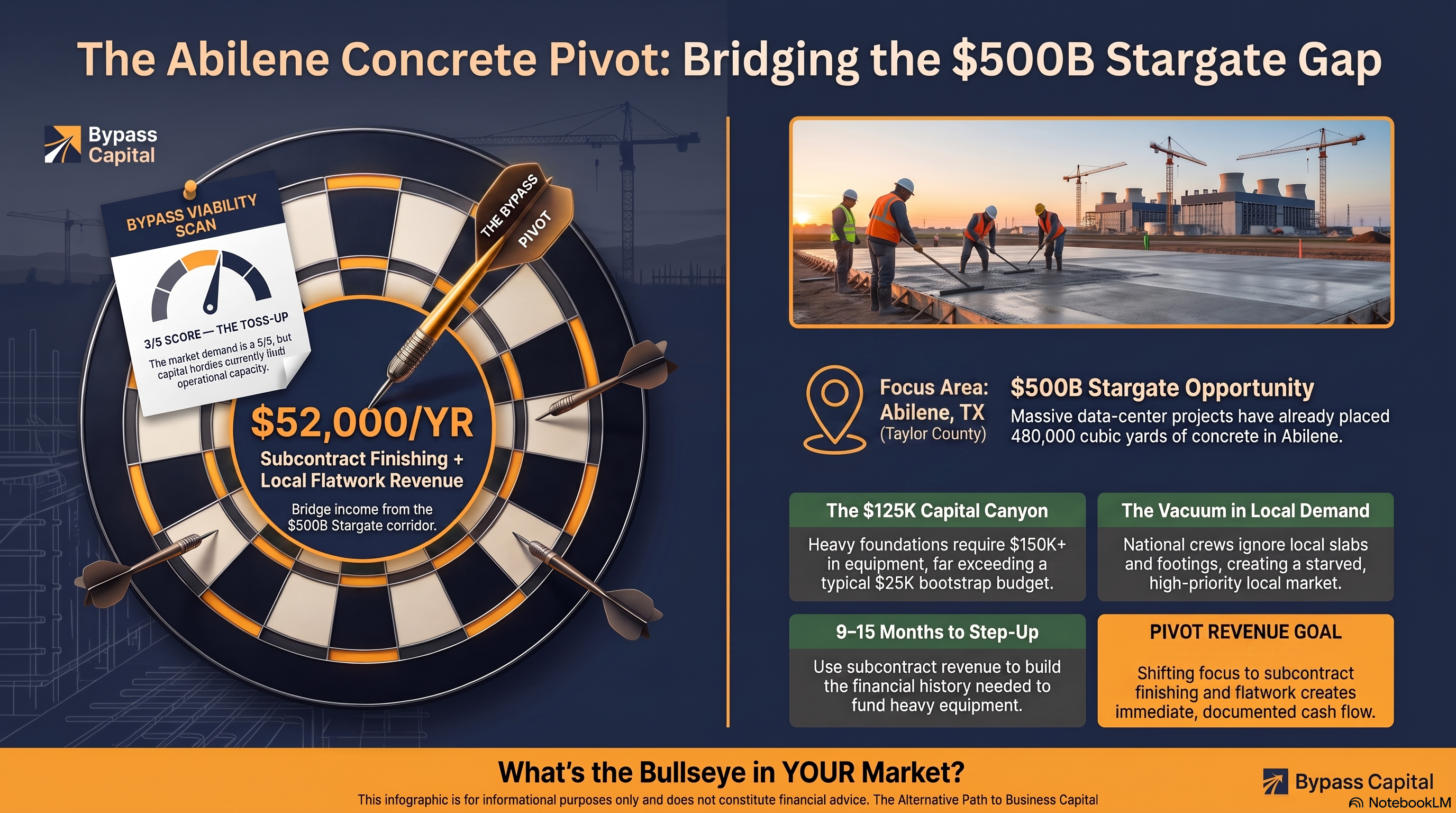
Abilene, Texas, is no longer just a mid-size market; it is the epicenter of a historic industrial transformation. The Stargate data-center project alone is a $500 billion behemoth that has already swallowed 480,000 cubic yards of concrete—the equivalent of 6,100 house foundations. But the scale doesn’t stop at the city limits. Just across the county line, the Vantage 1,200-acre campus is ramping up through 2028, sitting adjacent to a Microsoft-partnered 900 MW site. The region is onboarding 200+ workers a week. For a small operator with a $5,000 to $25,000 budget, the demand signal is a perfect 5/5. However, the reality of competing against national giants like DPR Construction, who bring their own batch plants and out-of-state crews, creates a "relatable problem" that breaks most businesses: how do you touch this once-in-a-generation wealth without getting crushed by the scale? The secret isn't in the "mega-pour"; it’s in the "Bypass Pivot."
Strategy 1: Mind the "Capital Canyon" — Why a 5/5 Demand is a 3/5 Opportunity
On paper, Abilene is a gold mine. In reality, the verdict for a small operator is a"3/5 — The Toss-Up." This is because of the "Capital Canyon"—the massive gap between a bootstrap budget and the heavy-load foundation equipment (laser screeds, ride-on trowels, pump access) required for data-center mats. In Texas, there is no statewide concrete-contractor license. This low barrier to entry means the market is flooded with "guys with trucks," but the lack of paper credentials makes the "equipment moat" even more significant. Many contractors chase "fantasy paths," attempting to self-finance $150,000 in specialized gear on a $25,000 budget. Without the ability to bond the project or sustain a massive crew, this is a fast-track to bankruptcy. "The demand is once-in-a-generation. Your capital gap is a canyon."
Strategy 2: The "Bypass Pivot" — Winning as a Tier-2 Subcontractor
The 80/20 truth of the Abilene boom is that national GCs are chasing 100% of the mega-pours and 0% of the overflow. The most profitable move for a skilled operator isn't bidding against DPR; it’s serving the Tier-2 subcontractors already on site. By providing finishing crews and flatwork, you leverage your existing 5+ years of skill without taking on massive equipment debt. This is a low-overhead, high-cash-flow play. You aren't the guy pouring the billion-dollar foundation; you’re the guy finishing the slabs that the national crews are too busy to handle. Positioning statement for the truck: "Abilene's go-to concrete finishing and flatwork crew — reliable labor and slabs while the whole town's building."
Strategy 3: The Riches in the "Local Vacuum"
When every experienced hand in Taylor County is pulled toward the Stargate or Vantage campuses, a "local vacuum" is created. National crews have a "Big Guy Weakness"—they are built for the mega-pour and disappear the moment the primary site work is done. This leaves the secondary economy—housing for 8,000 workers, retail strips, and light-commercial infrastructure—starving for attention. Local driveways and footings are being abandoned by Abilene shops chasing the "big site" money. This overflow is 20% of the market, but it is 100% reachable for an operator with a $25k budget. Occupy the space they abandoned, and you can charge premium rates for "small" jobs that are now high-priority for the community.
Strategy 4: Revenue is Your Best Financial Product
In the first 30 days, an LLC and a business account are more valuable than a new laser screed. Why? Because documented revenue turns your capital gap from a wall into a bridge. Instead of buying equipment, rent it or job-cost it into every pour. This keeps your balance sheet clean while you build a "paper trail" of success. Documented income through a formal business entity is the only thing that transforms you from a "laborer" into a "fundable enterprise." "Form your LLC now and land your first subcontract finishing or local flatwork job through a dedicated business account — documented concrete revenue is the single thing that turns your capital gap from a wall into a bridge."
Strategy 5: Find Your "Corner Man" for the Abilene Cage Match
Operating in West Texas is a "cage match." You are fighting the 100-degree heat that flash-cures every pour, out-of-state crews with deeper pockets, and a labor market where your best finishers are constantly being poached. Traditional banks will look at a $25,000 budget and a mega-project and show you the door. You need a "Corner Man"—a specialized partner like Bypass Capital that understands the "9–15 month" timeline to fundability. By documenting 9-15 months of subcontract revenue, you transform a "no" from a lender into a "yes" for the heavy equipment financing needed to bid on larger phases of the Vantage and Microsoft projects as they ramp up through 2028.
Tactical Timeline: The First 30 Days
●The One Action (Next 7 Days): Call the Tier-2 concrete subs working the Stargate and Vantage sites. Offer your crew as finishing/flatwork subcontract labor. This is your fastest path to a dollar without needing a $150k pump truck.
●The 30-Day Marker: You must have your LLC formed and at least one subcontract or local flatwork job booked through a dedicated business account. This is your proof of concept.
Conclusion: The Long Game
The sheer scale of a 480,000-cubic-yard pour can trick any contractor into overreaching. But trying to buy your way into the "Big Leagues" on a bootstrap budget is how you lose the fight before the first truck rolls. By bridging through subcontracting and capturing the local overflow, you can ride this industrial boom for the next decade. Are you chasing the headline-grabbing contract, or are you building the foundation that will actually let you own the market?
🏗️ Bypass Viability Report — Travis · Concrete Contractor · Abilene, TX
🟡 THE BYPASS VIABILITY GAUGE: 3 / 5 — "The Toss-Up"
📍 Territory Tier: Tier 2 — Mid-Size Market (Abilene / Taylor County, pop. ~130K city / ~180K metro — Stargate data-center corridor)
🚨 PIVOT RECOMMENDED: The demand is once-in-a-generation. Your capital gap is a canyon. See The Bypass Pivot.
Section 1 — THE VERDICT
Travis, I'm scoring this a 3, and I want you to understand why it's not a 5 — because the demand side sure looks like one. You've got the $500 billion Stargate campus dropped on your hometown, a project that's already placed 480,000 cubic yards of concrete — the equivalent of ~6,100 house foundations — with 8,000+ workers on site and more building still to come (BigCountryHomepage, 2026). And it doesn't stop there: just across the county line, Vantage is building a 1,200-acre, 2-GW campus running through 2028, plus a Microsoft-partnered 900 MW site adjacent (Epoch AI, 2026). The concrete demand in your backyard is historic. So why a 3? Because your hurdle is Lack of Capital, and the gap between a $5K–$25K budget and the heavy-load foundation equipment those pours require is a canyon. The opportunity is a 5. Your current capital position is a 2. The honest average is a 3 — and the whole report is about how you bridge that gap without pretending it isn't there.
Section 2 — THE LOCAL REALITY CHECK
The Competitive Landscape. Here's the twist, Travis: the megaprojects aren't being poured by Abilene shops. They're run by national GCs — DPR Construction leads the Stargate site — bringing in massive out-of-state concrete crews and their own batch capacity (local, BigCountryHomepage). A local crewman with $25K isn't bidding a data-center mat foundation directly. That's the reality check. Meanwhile the local Abilene market — the driveways, slabs, footings, and light-commercial work — is being stretched thin because every experienced hand in town is getting pulled toward the campus. That vacuum is your actual opening, not the mega-pour itself.
The Demand Signal. (1) A historic, multi-year construction wave — Stargate through early 2027, Vantage/Shackelford through 2028, plus Microsoft's adjacent site (regional, Epoch AI). (2) A documented labor and capacity shortage — the site is still onboarding 200+ workers a week (local). (3) A booming secondary economy: 8,000 workers need housing, retail, and infrastructure, and Abilene leaders are actively courting vendors and suppliers to serve the campus (local, KTXS, 2026).
The Big Guy Weakness. The national crews are built for the mega-pour and gone when it's done. They don't touch the subcontract overflow, the secondary site work, and the local slab-and-footing demand the boom is creating. Two gaps: (1) subcontractor/labor-supply bridge — providing finishing crews, flatwork, and specialized labor to the big GCs and their tier-2 subs rather than competing against them; and (2) the underserved local commercial and residential market the boom has starved of attention.
Local Factors. Texas has no statewide concrete-contractor license, which lowers the entry barrier — a double edge that means you compete on reliability and relationships, not paper. The single biggest local factor is equipment capital: heavy-load foundation work demands laser screeds, ride-on trowels, pump access, and reinforcement handling that your budget can't buy outright. That's the canyon.
Section 3 — THE BYPASS PIVOT — The 80/20 Move
Travis, your capital hurdle has an honest answer, and it's not "go bid a data-center foundation." It's become the subcontractor-to-the-boom — supply finishing crews and flatwork to the tier-2 subs feeding the megaprojects, and own the local slab/footing demand the boom has abandoned — then let that documented revenue finance your equipment step-up.
Positioning statement for the truck: "Abilene's go-to concrete finishing and flatwork crew — reliable labor and slabs while the whole town's building."
The capital math:
Fantasy path: try to self-finance $150K+ in heavy foundation equipment on a $25K budget to chase a pour you can't bond or crew. That's how you go broke fast.
Bridge path: lead with labor-and-finishing subcontract work (low equipment cost, immediate cash, you already have the 5+ years of skill) plus local flatwork and footings the national crews ignore. Rent or job-cost the specialized equipment per pour instead of buying it. Every documented month of that revenue is what turns your equipment financing from a "no" into a "yes."
Fastest path to first revenue → scale: Your goal is a full-time concrete business and your hurdle is capital, so sequence it like a bridge, not a leap. Land subcontract finishing work and local slabs first for immediate cash flow, build a documented revenue history, then finance the heavy equipment that lets you bid bigger pours directly as the Vantage and Microsoft phases ramp through 2028.
The 80/20 truth: The national crews are chasing 100% of the mega-pour and 0% of the overflow. That overflow — the subcontract labor and the starved local market — is the 20% that's actually reachable for a $25K operator, and it's the only path that builds the capital to reach the rest.
Section 4 — FUNDING READINESS
Travis, picture how your morning really starts. You lace up your boots and step straight into a cage match — and in your corner of Texas, half your opponents showed up from out of state with equipment you can't afford. In the other corners: national GC crews with laser screeds and batch plants, a labor market so hot every good finisher in town is getting poached, the West Texas heat flash-curing every pour, an equipment dealer whose foundation gear costs more than your whole budget, and a banker looking at $25K and a mega-project you can't directly bid. Half a dozen opponents before the first truck rolls. That's the job.
Every fighter who ever won under those lights had one thing in common: a corner man. Somebody who didn't throw the punches for him, but knew the fight, patched him up between rounds, and told him the truth about when to swing and when to wait. That's what Bypass Capital is — your corner man. And a good corner man never shoves a fighter into the ring before he's ready. Neither do we.
And Travis, I'm going to be straight with you the way a real corner man would: your hurdle is Lack of Capital, and right now you're in the bootstrap-and-build band. A $5K–$25K budget doesn't finance heavy foundation equipment, and no honest lender is going to pretend otherwise. What it does fund is entity formation and a subcontract finishing operation — and that operation is what builds the documented revenue that makes real equipment financing possible down the road.
The Single Most Important Action: Form your LLC now and land your first subcontract finishing or local flatwork job through a dedicated business account — documented concrete revenue is the single thing that turns your capital gap from a wall into a bridge.
Realistic Timeline: ~9–15 months to a fundable equipment position — LLC formed, a documented book of subcontract and local revenue, and a clear equipment-financing ask tied to specific upcoming pours.
And here's why the corner man matters when the bell finally rings, Travis. Bypass Capital works differently than a traditional lender: approval rates are higher, the process moves in days not months, the paperwork won't bury you, and there are equipment- and startup-focused funding options built for operators a bank flat-out won't touch. Once you've got documented revenue and a real equipment plan, we're the corner that finances your step-up faster than any bank would allow.
Next step: When you're ready to step into your corner, it starts with a standard application — it tells us where you stand and what you need, so the conversation opens with real answers, not guesswork. Apply here: [APPLICATION LINK]
Section 5 — THE NEXT MOVE
The One Action (next 7 days): Call the tier-2 concrete subs working the Stargate and Vantage sites and offer your crew as finishing/flatwork subcontract labor — that's your fastest dollar and it puts you inside the boom without needing the heavy equipment.
The 30-Day Marker: 30 days out you should have your LLC formed and at least one subcontract or local flatwork job booked through a business account — proof you can generate documented concrete revenue.
The Honest Warning: Travis, don't let the size of Stargate fool you into overreaching — an operator who tries to buy his way into the mega-pour on a bootstrap budget goes broke, while the one who bridges through subcontract work rides this boom for years.
Other note worthy case studies.
→How a semiconductor boom created a specialist lane most concrete contractors can't see →
→Wyatt's crew was never the problem — his estimating was. See the 4/5 fix →