The $165 Billion Concrete Trap_ Why Specialization is the Only Way to Win the Phoenix Semiconductor Boom
The $90,00/YR Precision Pivot
Andre's Path From Commodity Concrete to Semiconductor Specialist
⚠️ About This Case Study
These case studies are composite illustrations. The individuals featured are fictional and do not represent a real client. However, the market data, local opportunity, competitive landscape, pricing, and regulatory details referenced are based on real research for this trade and location. Results shown are illustrative of what the data suggests is possible — not a guarantee, promise, or projection of income. Your outcome depends on your effort, skill, capital, timing, and market conditions. Bypass Capital does not provide financial, legal, or tax advice. Always do your own due diligence and consult a qualified professional before starting or investing in any business.
Take a listen to the Deep Dive Podcast - Precision Concrete Strategy for Microchip Fabs
Below you can see what Andre's V-Scan looks like — see what yours could show
The $165 Billion Concrete Trap: Why Specialization is the Only Way to Win the Phoenix Semiconductor Boom
From Millions to Billions
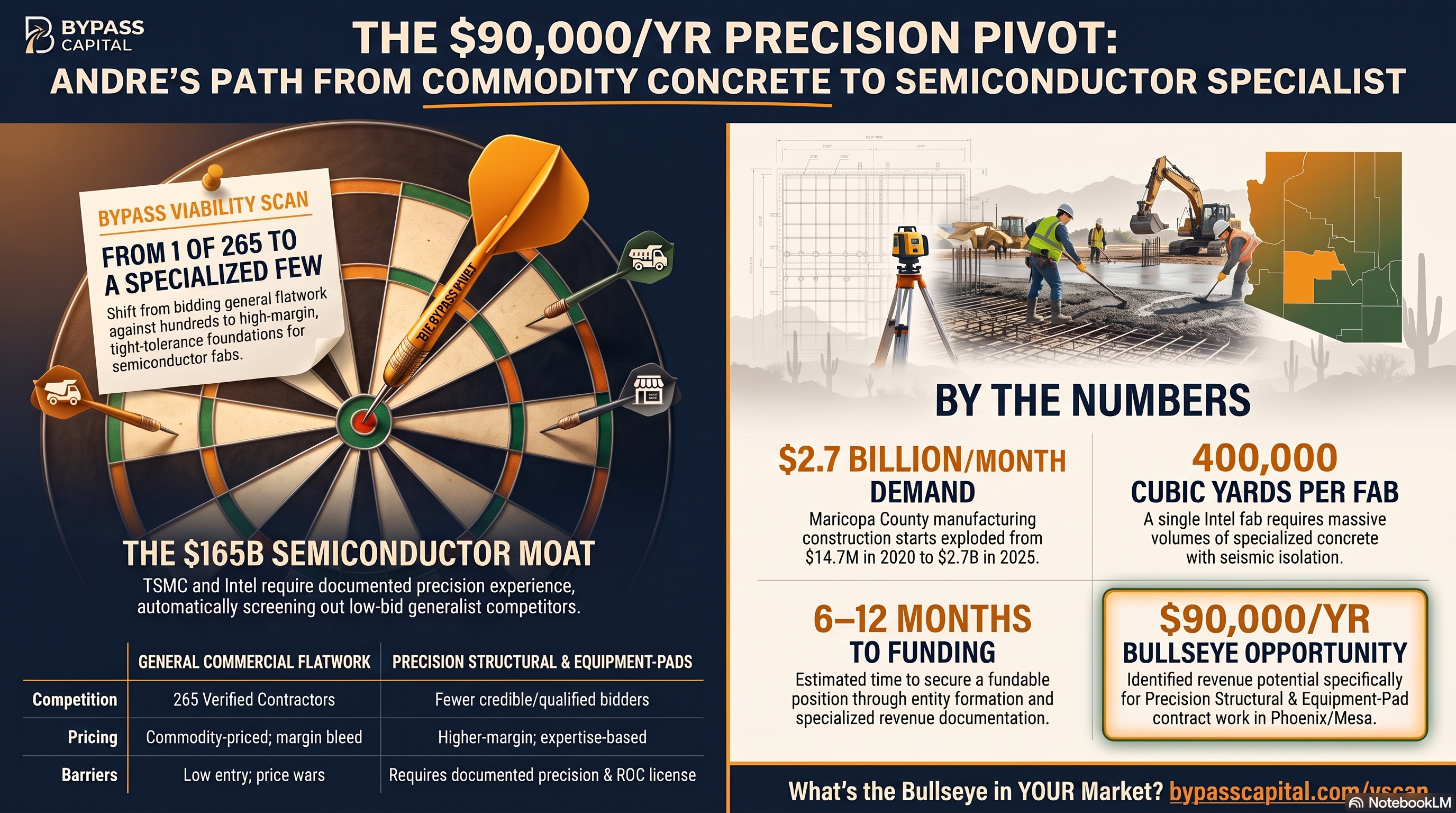
In 2020, manufacturing construction starts in Maricopa County were a quiet affair, averaging just $14.7 million per month. Fast forward to the reality of late 2025, and that figure has exploded to a staggering **** $2.7 billion per month . This isn't just a growth curve; it’s a vertical ascent driven by the $165 billion TSMC campus and Intel’s massive Ocotillo fabs. On paper, it looks like a gold rush. In reality, we’ve tagged this market with a3 / 5 — "The Toss-Up" viability verdict. Why? Because massive demand doesn’t guarantee a win if you’re just "contractor #266" lacing up your boots to step into a crowded cage match. If you walk onto the field as a generalist, you aren't building a business—you’re just fighting for scraps in a desert where the heat will flash-set your pours and your profits before you can even strip the forms.
The 265-Contractor Cage Match
The Phoenix and Mesa territories have become a Tier 1 battlefield. Currently, there are265 verified concrete contractors fighting for dominance. This is a dense, sophisticated landscape where "good enough" gets you buried. The market is anchored by incumbents like Suntec Concrete —the largest commercial concrete player in the Southwest—and established giants like CJS Enterprises(active since 1962), Cruz , and Keystone. These aren't just competitors; they are employee-owned machines with bonding capacities that a new entrant simply cannot match. If you try to play their game, you’ve already lost. "The 3 is a positioning problem, and specialization is the way out... Walk in as a general commercial pourer and you're competing on price against employee-owned giants with bonding capacity you can't match."
Fab-Grade Concrete: "A Different Animal"
To win here, you have to understand that semiconductor construction is a different breed of work. This is "Fab-Grade" concrete, where precision is infinitely more valuable than volume . While a single Intel fab might swallow400,000 cubic yards of concrete, the owner isn't looking for a bulk pour; they are looking for a technical moat.
●Seismic Isolation:Foundations designed to keep multi-billion dollar tools perfectly still.
●Ultra-Flat Floors:Precision tolerances that generic crews lack the gear or the patience to hit.
●Design-Build QA/QC: Stringent quality demands that favor the specialist over the low-bidder. These requirements act as a natural barrier. Semiconductor owners specify experience at the project level and actively screen out generalists . This is your moat. By focusing on high-spec work, you move the conversation away from "How cheap can you do it?" to "Do you have the expertise to handle this?"
The 80/20 Bypass Pivot
The "Commodity Path" is where 80% of the market lives, fighting over general flatwork and bleeding margin until there's nothing left. To survive, you must execute the 80/20 Move. The Specialist Path means ignoring the bulk of the commodity work to target the high-value 20%: the equipment foundations, machine pads, and precision structural work fortier-2 and tier-3 suppliers orbiting the TSMC and Intel corridors. These facilities are the lifeblood of the fabs, and they need specialized crews who understand tight tolerances. "The 265 general pourers are all fighting over the 80% of commodity flatwork. The 20%—precision structural and equipment-pad work—is where the margin lives and where your experience makes you one of a handful of credible bidders instead of one of 265."
The "Corner Man" and the Road to Readiness
In this environment, you’re up against six opponents at once: established giants, GCs squeezing your bid, the Arizona heat, ROC licensing requirements, fab owners who won't hire generalists, and a banking system that hesitates to fund a$5K–$25K budget in a metro full of established players. You need a "corner man"—someone who knows the fight, patches you up, and provides the strategic support to scale. That is the role of Bypass Capital . We don’t throw the punches, but we ensure you are fundable when the bell rings. This isn't an overnight process. Moving from an employee to a fundable owner requires a6-to-12-monthreadiness phase to build a trail of specialized revenue that a traditional bank would never touch. Immediate Requirements for Funding Readiness:
●LLC Formation:Move from a person to a legal entity.
●ROC License: Secure your Arizona Registrar of Contractors commercial concrete license in the company name.
●Documented Specialized Revenue: Run your first specialized pours through a dedicated business account to prove your niche. The 30-Day Marker: Within one month, you must have your LLC formed, your ROC license in motion, and at least one specialized-pour bid on the table.
Conclusion: The Seven-Day Challenge
The Phoenix semiconductor boom is a once-in-a-generation opportunity, but if you launch as just another general commercial pourer, you will drown on price. You must plant your flag as a specialist from day one. Your Seven-Day Challenge: Identify three GCs or tier-2 sub-contractors currently working the TSMC/Intel corridor or the downstream megaprojects. Pitch your crew specifically for precision structural or equipment-pad work , not general flatwork. Do you want to be contractor #266 fighting for scraps, or do you want to dominate the high-margin niche? The only version of this that works is the specialist version.
🏗️ Bypass Viability Report — Andre · Concrete Contractor · Phoenix / Mesa, AZ
🟡 THE BYPASS VIABILITY GAUGE: 3 / 5 — "The Toss-Up"
📍 Territory Tier: Tier 1 — Major Metro (Phoenix / Mesa / Maricopa County, pop. ~4.9M metro)
🚨 PIVOT RECOMMENDED: Huge demand, but a crowded field. Your edge is specialization. See The Bypass Pivot.
Section 1 — THE VERDICT
Andre, this is a 3, and it's a classic Toss-Up: the demand is enormous and the competition is just as thick. Maricopa County's manufacturing construction starts have exploded from $14.7M/month in 2020 to $2.7 billion/month by late 2025 — driven by TSMC's Arizona campus (now scaling toward $165 billion), Intel's Ocotillo fabs, and Amkor (ConstructConnect, Dec 2025). But here's the other side of the coin: the Mesa area alone lists 265 verified concrete contractors, bidding difficulty is rated High, and the market is anchored by heavyweights like Suntec Concrete — the largest commercial concrete company in the Southwest — plus CJS (est. 1962), Cruz, and Keystone (Downtobid, 2026). You've got 5+ years in commercial concrete, which is exactly what you need to escape the crowd — but as a general-concrete bidder you're one of 265. The 3 is a positioning problem, and specialization is the way out.
Section 2 — THE LOCAL REALITY CHECK
The Competitive Landscape. Dense and sophisticated. 265 verified concrete contractors in the Mesa area, avg response time 3 days, avg travel distance 38 miles (local, Downtobid). The top tier is formidable: Suntec Concrete (largest commercial concrete in the SW, employee-owned, structural/tilt-panel/foundation), CJS Enterprises (est. 1962, post-tension and multi-story), Cruz Concrete, Keystone, Fisher Industries (ready-mix + heavy civil). Walk in as a general commercial pourer and you're competing on price against employee-owned giants with bonding capacity you can't match.
The Demand Signal. (1) The semiconductor build-out — TSMC scaling toward $165B with a third fab in equipment-install phase and a fourth permitted; Intel Chandler; Amkor (regional, WCG, 2026). (2) Fab-grade concrete is a different animal — seismic isolation, ultra-flat floors, precision tolerances; a single Intel fab uses ~400,000 cu yd of concrete (national reference, AMTS). (3) A massive downstream wave — three $1B+ mixed-use megaprojects plus retail, residential, and civil work following the fabs into 2026 (local, ConstructConnect).
The Big Guy Weakness. The volume pourers compete on general commercial flatwork and tilt-panel at scale. The gap they leave — and the one your 5+ commercial years qualify you for — is precision, high-spec structural and equipment-pad work: the tight-tolerance pours, machine foundations, and fab-adjacent supplier facilities that reward expertise over raw volume. Semiconductor owners specify experience at the project level and won't accept generic crews (Birmingham Group, 2026) — that specificity is your moat.
Local Factors. Arizona requires an ROC (Registrar of Contractors) commercial concrete license and bonding — a real barrier that rewards a licensed, experienced operator and thins the field of low-bid generalists. Fab and downstream work increasingly runs design-build with QA/QC demands that favor a specialist.
Section 3 — THE BYPASS PIVOT — The 80/20 Move
Andre, your Competition hurdle breaks the moment you stop being "commercial concrete company #266" and become the precision structural / high-load pour specialist feeding the semiconductor and downstream boom. Your 5+ years in commercial concrete is the ticket the general pourers can't punch.
Positioning statement: "Phoenix's precision structural concrete specialist — tight-tolerance foundations and equipment pads built to fab-grade spec."
The specialization math:
Commodity path: bid general flatwork against Suntec and 264 others, win on price, bleed margin.
Specialist path: target equipment foundations, machine pads, tight-tolerance structural pours, and precision work for the tier-2/tier-3 supplier facilities orbiting TSMC and Intel — higher margin, fewer credible bidders, and owner requirements that actively screen out generalists. The downstream megaprojects add a second lane of high-spec structural work into 2026.
Fastest path to first revenue → scale: Your goal is a full-time concrete business and your hurdle is competition, so lead with your specialization to the GCs and tier-2 subs already working the fab corridor — they need credible precision crews and can't find enough of them. Land that specialized work first, build a fab-grade reputation, then scale crews as the third and fourth TSMC fabs and downstream projects ramp.
The 80/20 truth: The 265 general pourers are all fighting over the 80% of commodity flatwork. The 20% — precision structural and equipment-pad work — is where the margin lives and where your experience makes you one of a handful of credible bidders instead of one of 265.
Section 4 — FUNDING READINESS
Andre, picture how your morning really starts. You lace up your boots and step into a cage match — and in Phoenix the ring is packed with 265 other concrete outfits before you've even thrown a punch. In the other corners: Suntec and the employee-owned giants with bonding capacity you can't match, GCs squeezing every bid on price, the desert heat flash-setting your pours, an ROC licensing and bonding requirement, a fab owner who won't let a generalist near his foundation, and a banker weighing a $5K–$25K budget against a metro full of established competitors. Six opponents deep, every day. That's the job.
Every fighter who ever won under those lights had one thing in common: a corner man. Somebody who didn't throw the punches for him, but knew the fight, patched him up between rounds, and told him the truth about when to swing and when to wait. That's what Bypass Capital is — your corner man. And a good corner man never pushes a fighter into the ring before he's ready. Neither do we.
Your hurdle is Competition, not capital — but let's be honest about your position. At 5+ years, still employed by a commercial concrete company, with a $5K–$25K budget, you're in the entity-formation-and-documentation band. The skill and the specialization angle are there; what a lender needs to see is the LLC, the ROC license in your own name, and documented specialized revenue that proves you can win the high-spec work.
The Single Most Important Action: Form your LLC and pull your ROC commercial concrete license into the business now, then run your first specialized pour through a dedicated business account — documented fab-grade revenue is what separates you from the 265 generalists in a lender's eyes.
Realistic Timeline: ~6–12 months to a fundable position — entity and licensing squared, clean business banking, and a documented stack of specialized structural work you can point to.
And here's why the corner man matters when the bell finally rings, Andre. Bypass Capital works differently than a traditional lender: approval rates are higher, the process moves in days not months, the paperwork won't bury you, and there are funding options built for startup operators a bank can't match. Once your entity and specialized revenue trail are in place, we're the corner that funds your crew and equipment scale-up faster than any bank would allow.
Next step: When you're ready to step into your corner, it starts with a standard application — it tells us where you stand and what you need, so the conversation opens with real answers, not guesswork. Apply here: [APPLICATION LINK]
Section 5 — THE NEXT MOVE
The One Action (next 7 days): Identify the three GCs or tier-2 subs working the TSMC/Intel corridor or the downstream megaprojects and pitch your crew specifically for precision structural or equipment-pad work — not general flatwork. That's your escape from the pack.
The 30-Day Marker: 30 days out you should have your LLC formed, ROC license in the business name, and at least one specialized-pour conversation or bid in motion.
The Honest Warning: Andre, if you launch as one more general commercial pourer in a 265-deep field, you'll drown on price — the only version of this that works is the specialist version, so plant that flag from day one.
Explore the data behind Andre's pivot from commodity pourer to precision concrete specialist — 265 competitors mapped against Phoenix's semiconductor boom.
Here are a couple other V-Scan Case Studies you may find interesting.
→Wyatt's crew was never the problem — his estimating was. See the 4/5 fix →
→Why a Bakersfield HVAC tech stopped chasing $385 repairs and started chasing Title 24 retrofits →