Reno's 20.8 Million Square Foot Problem
Reno's 20.8 Million Square Foot Problem — Concrete V-Scan Case Study | Bypass Capital
⚠️ About This Case Study
These case studies are composite illustrations. The individuals featured are fictional and do not represent a real client. However, the market data, local opportunity, competitive landscape, pricing, and regulatory details referenced are based on real research for this trade and location. Results shown are illustrative of what the data suggests is possible — not a guarantee, promise, or projection of income. Your outcome depends on your effort, skill, capital, timing, and market conditions. Bypass Capital does not provide financial, legal, or tax advice. Always do your own due diligence and consult a qualified professional before starting or investing in any business.
Deep Dive Podcast of Winning mid-size contracts with the V-Scan
The "Goldilocks" Gap: Why the Reno Concrete Boom is Leaving Mega-Contractors Behind (and How Locals Win)
1. Introduction: The High-Desert Industrial Gold Rush
In the high desert of Northern Nevada, the physical grit of concrete forms is colliding with a massive, high-tech industrial expansion. Reno and Sparks have emerged as the premier industrial hub of the West, boasting120 million square feet of inventory anchored by the Tahoe Reno Industrial Center (TRIC) . This "Gold Rush" is fueled by a relentless tax-magnet economy—featuring no state income tax and utility costs approximately 61% below California .Hyperscalers like Tesla, Google, and Microsoft are pouring billions into the region, yet many talented local tradespeople are failing to capture the value. The paradox is simple: they are losing not because of a lack of skill with a trowel, but because they haven't navigated the "Goldilocks" gap . This is the strategic space between small-scale residential work and the massive "mega-pours" that attract national attention.
2. The Fortune is in the "Mid-Size" Gap
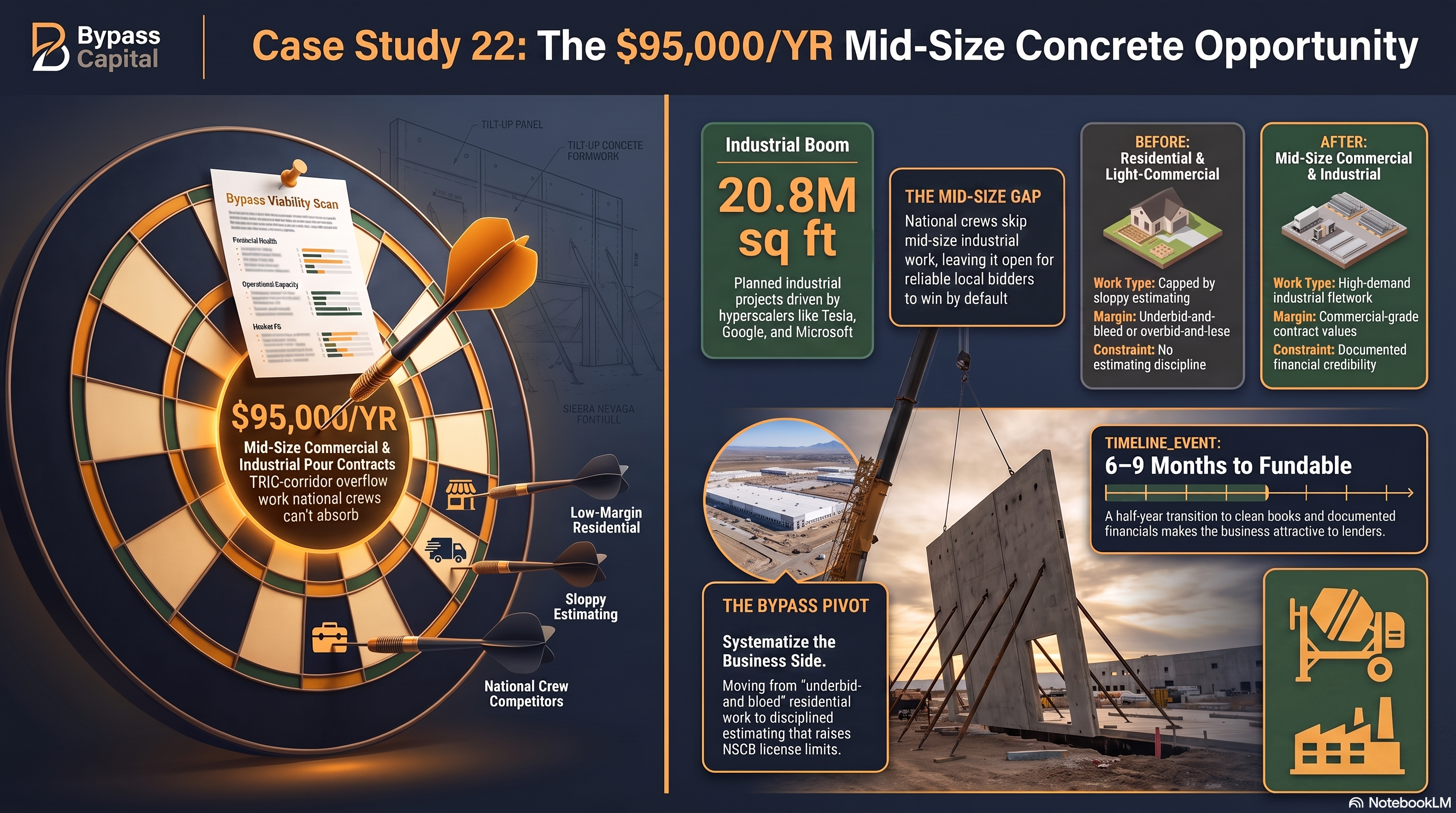
The arrival of national contractors like the Phoenix-based Nox Group is often viewed as a threat, but for a disciplined local, it is a massive opportunity. These giants are optimized for "mega-pours," such as the1.7 million square foot Tesla Semi factory or Microsoft’s 300-acre development at the Victory Logistics District . By chasing the largest projects, national firms leave a vacuum in the mid-size commercial and industrial sector. National crews lack the agility to profitably manage equipment pads, tilt-up footings, and site flatwork for the dozens of downstream facilities popping up in the Mark IV infrastructure corridor. In a Tier 2 market, word-of-mouth among General Contractors travels fast, and being the local who can handle these "smaller" $500k to $2M jobs is a genuine moat .The incoming national contractors are built for the mega data-center pours. What they leave open is the mid-size commercial and industrial concrete work... that a disciplined local operator can win if they can estimate and bid it properly.
3. The 80/20 Rule of the Trowel
In a hyper-growth market like Reno, physical trowel skill is no longer your primary competitive advantage; it is the baseline requirement. Strategic growth is governed by the 80/20 rule:80% of your success is decided before the first yard of concrete is ever poured . Many contractors stay on the "Stuck Path," relying on sloppy estimates that lead to underbidding and financial bleeding. To transition to the "Gap Path," you must recognize that your business systems are your actual product. A "moat" is built on three specific pillars of business discipline:
●Accurate, professional bids that account for true overhead and margin.
●The ability to bond work , which signals institutional reliability to GCs.
●Consistent schedule delivery that aligns with high-velocity industrial cycles.
4. Your License is a Financial Document, Not a Skill Certificate
A critical reality many tradespeople overlook is the specific logic of the Nevada State Contractors Board (NSCB) . In Nevada, your license limit is not a reflection of your years on the job; it is a monetary limit tied directly to your demonstrated financial capacity . This makes the business side your ultimate gatekeeper. If your bookkeeping is an afterthought, your license limit will remain capped, effectively barring you from the industrial boom regardless of your field experience. In this environment, clean financials are a competitive weapon used to lift your ceiling and unlock larger commercial bids. Your license limit, bonding, and bid credibility all flow from documented financials.
5. The "Cage Match" Mentality and the Need for a Corner Man
Operating a concrete firm in Reno-Sparks is a daily cage match . Your opponents are not just the national crews or the NSCB limits; they are the high-desert technical challenges like frost heave, seismic codes, and extreme temperature swings . Navigating these while managing a "stack of bids on the truck seat" is a recipe for exhaustion. Winning requires a "corner man"—a specialized industrial capital partner who understands the math of the fight and prepares you for "Funding Readiness." This is a 6–9 month strategic window used to systematize job-costing and clean up books. You cannot scale into industrial work overnight; you must build the financial runway that makes you fundable by lenders and bonding companies.
6. Conclusion: The Window is Open, But Not Forever
The Reno/Sparks market currently offers a rare alignment of massive demand and a specific capacity gap, with20.8 million square feet of industrial projects already entitled or planned for the next cycle. However, the window for a local to establish themselves as the "reliable commercial sub" will not stay open indefinitely. The most urgent move is a business-systems upgrade , not a field-skill upgrade. Within the next30 days , a serious operator should have their LLC and books running clean and at least one commercial bid submitted through a repeatable estimating system. Are you currently bidding blind and staying stuck in the residential loop, or are you building the infrastructure to own the boom? The only thing keeping you out of the industrial game is letting the business side stay sloppy another year.
This is what Wyatt's V-Scan looked like — see what yours could show
🏗️ Bypass Viability Report — Wyatt · Concrete Contractor · Reno / Sparks, NV
🔵 THE BYPASS VIABILITY GAUGE: 4 / 5 — "The Market Gap"
📍 Territory Tier: Tier 2 — Mid-Size Market (Reno / Sparks / Washoe County, TRIC corridor)
✅ FULL THROTTLE: Strong demand, fixable hurdle. Your gap is business discipline — close it and this is a runway.
Section 1 — THE VERDICT
Wyatt, this earns a 4, and I'll tell you exactly why. Northern Nevada is one of the strongest industrial construction markets in the West — 120 million sq ft of industrial inventory anchored by the Tahoe Reno Industrial Center (Tesla's Gigafactory, Google/Alphabet data centers), with Microsoft buying 300 acres for data centers at Victory Logistics District and Mark IV opening another 600 acres of infrastructure-ready land (Terrapin Construction Group, 2026). Phoenix-based data-center builder Nox Group just expanded into Reno to chase the demand (NNBW, Mar 2026). The demand is real, the field is far less saturated than Phoenix, and you've got 3–5 solid years of skill. So why not a 5? Because your hurdle is the Business Side — and in commercial concrete, the operators who win the big pours win them on estimating and bidding discipline, not trowel skill. Close that one gap and this market is a runway. That's what makes it a 4 with a clear path up.
Section 2 — THE LOCAL REALITY CHECK
The Competitive Landscape. Healthier than the metros. The Reno-Sparks concrete field is a mix of full-site contractors like Reno Tahoe Construction (site grading, utilities, paving, concrete for commercial/industrial) and residential/light-commercial shops (local, Reno Tahoe Const.). It's competitive but not the 265-deep dogpile of Mesa — and critically, national players like Nox Group are arriving because local capacity can't keep up with data-center demand (regional, NNBW). That capacity gap is your opening — if you can bid the work credibly.
The Demand Signal. (1) A structural data-center and industrial boom — Microsoft's 300 acres, Mark IV's 600 acres, TRIC hyperscalers, and 20.8M sq ft of industrial projects entitled or planned for the next cycle (regional, Terrapin). (2) Advanced-manufacturing inflow — Tesla's 1.7M sq ft Semi factory, Amperesand's new transformer plant, expanding fabricators (regional, NNBW). (3) A tax-magnet economy — no state income tax, utility costs ~61% below California — pulling businesses and their facilities east (state, Terrapin).
The Big Guy Weakness. The incoming national contractors are built for the mega data-center pours. What they leave open is the mid-size commercial and industrial concrete work — equipment pads, tilt-up footings, site flatwork, and the supplier/downstream facilities — that a disciplined local operator can win if they can estimate and bid it properly. The gap here isn't skill in the market; it's operators who run the business side well enough to bond, bid, and deliver commercial work rather than staying stuck in residential.
Local Factors. Nevada requires NSCB (Nevada State Contractors Board) licensing with a monetary limit tied to your demonstrated financial capacity — which is exactly why the business side is your gate: your license limit, bonding, and bid credibility all flow from documented financials. High-desert design (frost heave, seismic, temperature swings) adds a technical layer that rewards a competent local.
Small Market Advantage. Wyatt, this is the part the Phoenix guys don't get. In a mid-size market with national crews arriving faster than local capacity can absorb, a disciplined local operator becomes the reliable go-to for the GCs who can't get the big players to bid their mid-size work. Word of mouth among Reno-Sparks GCs travels fast, your customer-acquisition cost is a fraction of a major metro's, and being one of the few locals who can actually bid and bond commercial work is a genuine moat.
Section 3 — THE BYPASS PIVOT — The 80/20 Move
Wyatt, at a 4 this isn't a trade change — it's a business-systems upgrade. You don't need new skills in the field; you need estimating and bidding discipline that lets you move from residential/light work into the mid-size commercial and industrial pours the boom is creating and the national crews are skipping.
Positioning statement: "Reno-Sparks' reliable commercial concrete partner — accurate bids, bonded work, delivered on schedule."
The business-side math:
Stuck path: strong crew, sloppy estimates — you either underbid and bleed or overbid and lose, and you stay capped in residential.
Gap path: build a real estimating system (accurate takeoffs, proper overhead and margin, competitive but profitable bids), get your NSCB limit raised through documented financials, and step into commercial equipment pads, tilt-up footings, and industrial flatwork — where Reno's data-center and manufacturing boom is starving for reliable mid-size subs.
Fastest path to first revenue → scale: Your goal is a full-time concrete business and your hurdle is the business side, so the sequence is: systematize estimating and bookkeeping first, use clean financials to lift your NSCB license limit, then bid the mid-size commercial work the GCs are struggling to fill. The discipline unlocks the ceiling.
The 80/20 truth: In commercial concrete, 80% of the winning is decided before the pour — in the estimate, the bid, and the bond. Master that 20% of the business that field guys ignore, and you'll out-compete better trowels who can't run their numbers.
Section 4 — FUNDING READINESS
Wyatt, picture how your morning really starts. You lace up your boots and step into a cage match — and your toughest opponent isn't even in the ring with you, it's the stack of bids and paperwork on your truck seat. In the other corners: national crews like Nox Group arriving to grab the big pours, GCs who need accurate numbers yesterday, the high-desert frost and seismic code, the NSCB holding your license limit hostage to your financials, a bonding company wanting clean books, and a banker who wants to see you can actually run the business. Half a dozen opponents before the first form goes up. That's the job.
Every fighter who ever won under those lights had one thing in common: a corner man. Somebody who didn't throw the punches for him, but knew the fight, patched him up between rounds, and told him the truth about when to swing and when to wait. That's what Bypass Capital is — your corner man. And a good corner man never pushes a fighter into the ring before he's ready. Neither do we.
Here's the good news, Wyatt: your hurdle is the Business Side, and that's the most fundable hurdle there is — because fixing it produces exactly the paperwork a lender wants. At 3–5 years with a $5K–$25K budget, you're in the systematize-and-document band. The market's a 4; the moment your books, estimating, and NSCB limit are in order, you're not just fundable — you're the kind of operator lenders and bonding companies compete for.
The Single Most Important Action: Get your LLC, bookkeeping, and estimating system running now, then use those clean financials to raise your NSCB license limit — that single move unlocks both the bigger commercial bids and your fundability at the same time.
Realistic Timeline: ~6–9 months to a strong fundable position — entity and books clean, NSCB limit raised, and a documented pipeline of commercial bids and awards.
And here's why the corner man matters when the bell finally rings, Wyatt. Bypass Capital works differently than a traditional lender: approval rates are higher, the process moves in days not months, the paperwork won't bury you, and there are funding options built for growing operators a bank can be slow to serve. Once your business side is buttoned up, we're the corner that funds the equipment and working capital to scale into the commercial pours faster than any bank would allow.
Next step: When you're ready to step into your corner, it starts with a standard application — it tells us where you stand and what you need, so the conversation opens with real answers, not guesswork. Apply here: [APPLICATION LINK]
Section 5 — THE NEXT MOVE
The One Action (next 7 days): Set up proper job-costing and a repeatable estimating template (takeoff → overhead → margin), and re-price your last three jobs with it — you'll immediately see where you've been leaving money on the table or bidding blind.
The 30-Day Marker: 30 days out you should have your LLC and books running clean and at least one commercial bid submitted using your new estimating system.
The Honest Warning: Wyatt, this market won't wait — with national crews pouring into Reno and 20M+ sq ft planned, the window for a local to establish himself as the reliable commercial sub is now, and the only thing that keeps you out of it is letting the business side stay sloppy another year.
See the full estimating-and-bidding turnaround behind Wyatt's 4-out-of-5 score — the Reno industrial boom, the numbers, and the systems fix that unlocks it.
Click here to see Wyatt's Slide Deck.
Some other Case Studies from our library that might interest you.
→172 HVAC competitors in one metro — see how Carlos found the $7,400 gap between them →
→One Tucson plumber's pivot from one-off repairs to $4,800/year commercial contracts →