Rae's Story — The Toss-Up
The $32,000 Bridge: Rae's Mobile Welding Pivot
⚠️ About This Case Study
These case studies are composite illustrations. The individuals featured are fictional and do not represent a real client. However, the market data, local opportunity, competitive landscape, pricing, and regulatory details referenced are based on real research for this trade and location. Results shown are illustrative of what the data suggests is possible — not a guarantee, promise, or projection of income. Your outcome depends on your effort, skill, capital, timing, and market conditions. Bypass Capital does not provide financial, legal, or tax advice. Always do your own due diligence and consult a qualified professional before starting or investing in any business.
Take a listen to the Deep Dive Podcast - Mobile Welding for West Texas Data Centers
Below you can see what Rae's V-Scan looks like — see what yours could show
The Permian Pivot: Why the Smartest Mobile Welders Aren’t Buying Trucks (Yet)
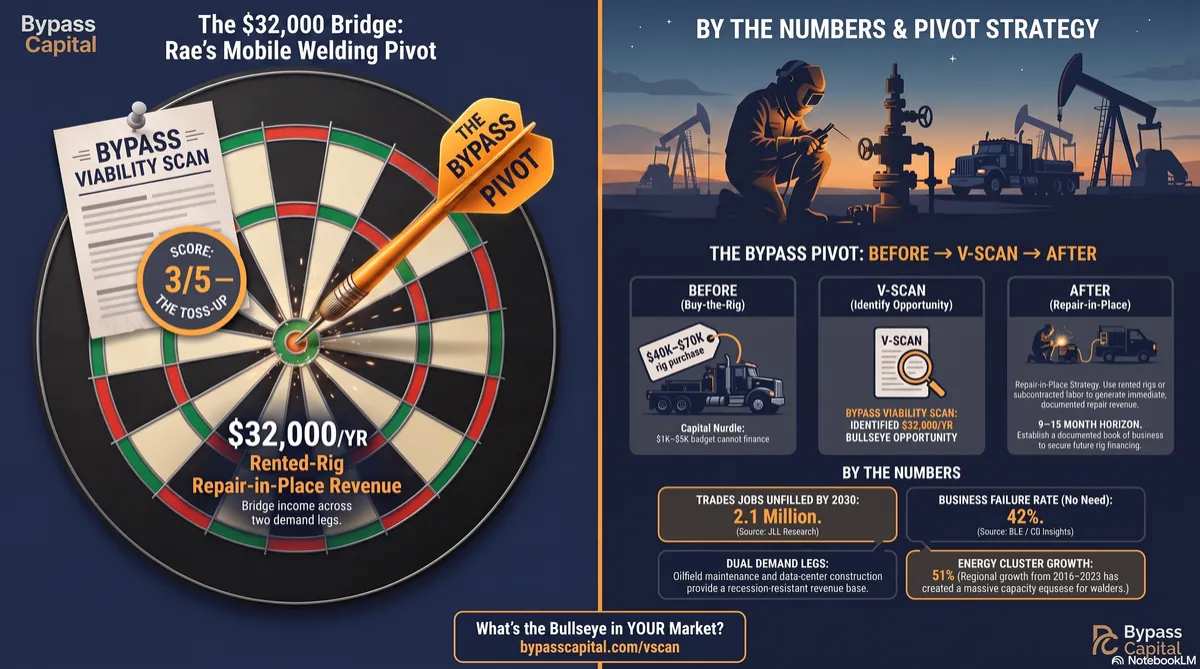
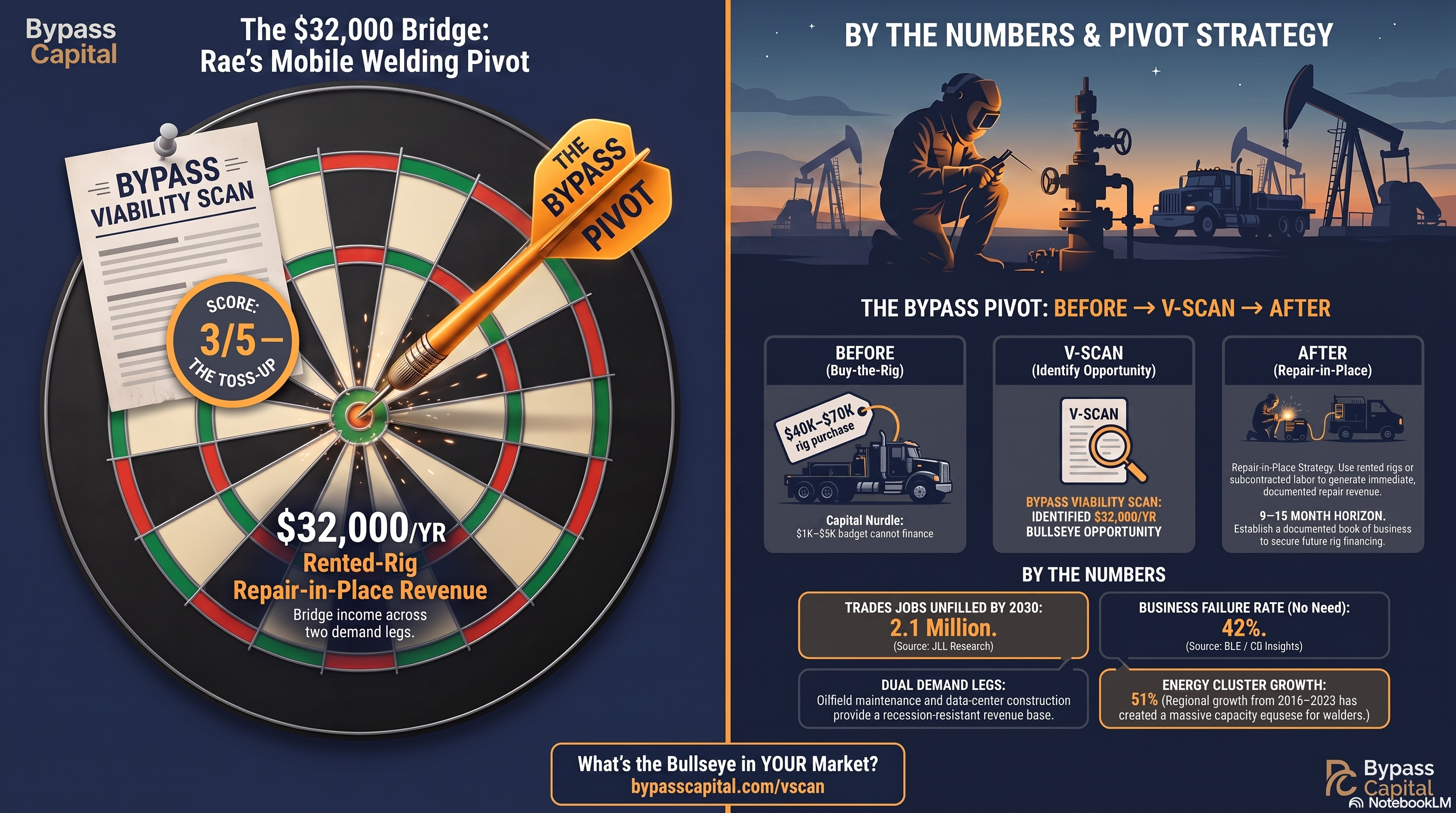
West Texas is home to the loudest welding market in the world right now. The Permian Basin accounts for roughly half of all U.S. oil production, and the region’s energy-and-mining cluster grew by a staggering 51% between 2016 and 2023 (Dallas Fed, 2026). Yet, despite this massive demand, many talented operators find themselves "stalled" at the starting line. This creates a specific paradox I call"3/5 Viability. "In this scenario, market demand is a clear 4 out of 5, but your available capital sits at a 2. We call this status "The Toss-Up. "It’s the point where most welders make a catastrophic mistake: they try to buy the gear before they’ve built the business. Success in the Permian isn't about the shiny rig you own on day one; it’s about the "bridge" you build to get to a fully funded operation.
The "Double-Leg" Demand (It's Not Just Oil Anymore)
Historically, being a welder in Midland or Odessa meant your life was tethered to the volatile swings of oil prices. While the energy sector remains a massive maintenance base, a second "demand leg" has emerged that is changing the game: data centers. Data center construction in the Basin has become so intensive that it now represents a massive portion of the local fabrication backlog. Major projects like FO Permian in Midland County and Texas Critical Data Centers in Ector County are driving a structural steel boom (Odessa American, 2026). The capacity squeeze is so tight that one Big Spring fabrication shop recently dropped $3 million on robotic welders just to keep up, with data center work now making up a third of their backlog (MRT, May 2026). For a new operator, this diversification provides a "stability edge"—if oil cools, the AI infrastructure build-out is usually still red-hot.
Exploiting the "Big Guy" Weakness
The Permian is dominated by majors like Halliburton and mid-tier giants like Saulsbury, Stallion, and SCS Industrials. These companies are built for large-scale contract fabrication and shop work. However, their massive size is their greatest weakness when it comes to the "scattered, urgent, drive-out-to-the-lease" repair niche. The majors are currently hoovering up every skilled hand for full-time payrolls, leaving a massive opening for nimble, independent operators. This is where you win. The "Big Guys" focus on:
●Large-scale contract fabrication and predictable shop schedules.
●Long-term projects with massive overhead.
●Work that requires hauling equipment to a central facility. What they leave behind for you:
●The broken bucket on a backhoe that’s stalling a job site.
●The cracked frame that’s too expensive to haul to town.
●The urgent wellhead fix that needs an arc struck right now .To dominate this gap, your positioning must be crystal clear: "Permian field repair welding — I come to your lease and fix it in place, so you’re not hauling it to town."
The $5,000 Trap and the 80/20 Solution
I see it every day: the "Fantasy Path." A welder tries to buy a fully outfitted$40,000–$ 70,000 rig with a$1,000–$ 5,000 budget. Don't do it. Draining your limited cash on a stripped-down, unreliable truck will cost you your reputation and your sanity when it breaks down on a caliche road. It is a business-killing move. The "Bridge Path" is the 80/20 solution. The big shops chase 100% of the contract work, but the 20% they leave on the table—the urgent, scattered field repairs—is the fastest path to revenue. Instead of buying a rig, rent one per contract or subcontract your labor to shops that already own the trucks. To a lender, documented revenue from these jobs is a bridge; a beat-up truck bought with cash is just a liability.
You Need a "Corner Man," Not Just a Banker
The West Texas market is a cage match. Between the 110°F heat, the caliche roads that chew up tires, and an equipment dealer whose rig costs more than your whole budget times ten, you’re facing half a dozen opponents before you ever strike an arc. Out here, the patch doesn't pull punches. You don’t just need a loan; you need a "Corner Man. "Traditional banks focus on collateral and mountains of paperwork; they often won't touch a mobile operator without a truck. Specialized trade funding— Bypass Capital —works differently. We focus on proven demand and speed. A good corner man doesn't shove a fighter into the ring before they're ready. We help you turn that "bootstrap" position into a fundable business by focusing on your revenue, not just your assets.
The 7-Day Revenue Challenge
If you want to move from a "Toss-Up" to a professional business owner, you must stop focusing on the truck and start focusing on the dollar. Documented welding revenue is the single thing that makes rig financing possible. Your Next 7 Days:
Form your LLC: Use your initial budget to establish a professional entity immediately.
Contact Site Subs: Call oilfield service shops and data-center site subcontractors in Midland-Odessa.
Offer Labor-Only or Rented-Rig Services: Position yourself as the repair-in-place specialist who saves them the haul-away cost.
Document Everything: Use a dedicated business account for every cent you earn. "Documented welding revenue is the single thing that makes rig financing possible."
From Bootstrap to Build
The transition from a "bootstrap" position to a "fundable rig position" typically takes 9–15 months. During this window, your goal is to build a documented book of business in both the oilfield and data-center sectors. The question isn't whether you have a truck today; the question is whether you are building a business or just buying a hobby. By using the "Bridge Path," you prove the demand first, and eventually, the revenue buys the rig for you. When you are ready to stop guessing and start building a documented history of success, it’s time to step into the corner. Apply to Step into Your Corner Here
🔧 Bypass Viability Report — Rae · Mobile Welding · Permian Basin (Midland/Odessa, TX)
🟡 THE BYPASS VIABILITY GAUGE: 3 / 5 — "The Toss-Up"
📍 Territory Tier: Tier 2 — Mid-Size Market (Midland/Odessa MSAs, pop. ~347K — Permian Basin core)
🚨 PIVOT RECOMMENDED: Two demand legs, one thin rig. Your hurdle is the rig itself. See The Bypass Pivot.
Section 1 — THE VERDICT
Rae, I'm calling this a 3, and it's an honest one. The demand around you is loud — the Permian Basin accounts for roughly half of U.S. oil production, and Midland-Odessa's energy-and-mining cluster grew 51% from 2016–2023, dragging metal manufacturing and fabrication right up with it (Dallas Fed, 2026). And there's a second leg opening up: data-center construction has gotten so hot that one Big Spring fab shop just dropped $3 million on robotic welders to keep up, and data-center work is now a third of their backlog (MRT, May 2026). So why a 3 and not higher? Two reasons: your hurdle is Market Support — you're part-time with a $1K–$5K budget, and in mobile welding the rig is the business. You can't chase oilfield repair-in-place work without a properly outfitted truck, and $1K–$5K doesn't buy one outright. The demand is a 4; your current rig-and-capital position is a 2. That averages to a real, workable 3.
Section 2 — THE LOCAL REALITY CHECK
The Competitive Landscape. The Permian runs on oilfield service companies — the majors like Halliburton and the mid-tier fab/service shops (Saulsbury, Stallion, SCS Industrials) dominate the shop and contract fabrication (Dallas Fed). But mobile, in-the-field repair welding is a different animal: it's fragmented, relationship-driven, and chronically short-handed because every skilled hand gets pulled onto full-time oilfield payroll. That labor pull is exactly your opening — the field needs mobile welders who show up, but the pay-hungry majors keep hoovering up the talent.
The Demand Signal. (1) A massive, ongoing oilfield maintenance base — pipe, wellhead equipment, tanks, and structural steel that break in the field and are cheaper to fix in place than haul away (regional, Dallas Fed). (2) A brand-new data-center/AI construction leg — FO Permian in Midland County, Texas Critical Data Centers in Ector County, and behind-the-meter power builds, all needing structural steel and skid work (Odessa American, 2026). (3) A documented capacity squeeze — fab shops are literally buying robots because they can't hire enough welders (local, MRT).
The Big Guy Weakness. The big service companies chase the large contract and shop-fab work. What they don't love is the scattered, urgent, drive-out-to-the-lease repair job — the broken bucket, the cracked frame, the wellhead fix that needs a welder on-site today. That repair-in-place niche is where a nimble mobile operator beats the haul-away model every time.
Local Factors. Two demand legs — oil and data centers — means Rae isn't purely exposed to oil-price swings, which is a genuine stability edge. But the West Texas reality is harsh: brutal heat, caliche roads, and long drive distances that eat fuel and time. And the gating factor is the rig — a properly equipped welding truck (welder, generator, gas, tooling, 4×4) is the capital question the whole business hinges on.
Section 3 — THE BYPASS PIVOT — The 80/20 Move
Rae, your Market Support hurdle isn't about whether the work exists — it plainly does. It's about getting a revenue-generating rig on the road without the capital to buy one outright. The pivot is a rent/lease-the-rig, repair-in-place bridge: start with the lowest-capital, highest-urgency field repair work, rent or job-cost the rig per contract instead of buying, and let documented revenue finance your own truck.
Positioning statement: "Permian field repair welding — I come to your lease and fix it in place, so you're not hauling it to town."
The rig-capital math:
Fantasy path: try to buy a fully-outfitted $40K–$70K welding rig on a $1K–$5K budget. Can't be done, and pretending otherwise stalls you before you start.
Bridge path: lead with repair-in-place field work you can take on with a rented or borrowed rig, or by subcontracting your labor to a shop that already owns the truck. Every documented month of field-repair revenue is what turns a rig loan from a "no" into a "yes."
Fastest path to first revenue → scale: Your goal is a full-time mobile welding business and your hurdle is market support (really, the rig), so sequence it like a bridge, not a leap. Land oilfield and data-center repair-in-place work first — subcontracting your certified hands or renting a rig per job — build a documented book of business, then finance your own rig once the revenue proves the demand.
The 80/20 truth: The big shops chase 100% of the contract fab work. The 20% they leave on the table — the urgent, scattered, repair-in-place field jobs — is exactly the reachable work for a part-time operator with a rented rig, and it's the fastest path to the capital that buys your own.
Section 4 — FUNDING READINESS
Rae, picture how your morning really starts. You lace up your boots and step straight into a cage match — and out here in the oil patch your opponents don't pull punches. In the corners: the oilfield service majors who poach every skilled welder in the Basin, the 110°F heat and caliche roads chewing up your day, oil-price swings that can cool the whole field overnight, an equipment dealer whose rig costs more than your whole budget times ten, and a banker looking at a $1K–$5K budget and a part-time welder with no truck of her own. Half a dozen opponents before the first arc strikes. That's the job.
Every fighter who ever won under those lights had one thing in common: a corner man. Somebody who didn't throw the punches for her, but knew the fight, patched her up between rounds, and told her the truth about when to swing and when to wait. That's what Bypass Capital is — your corner man. And a good corner man never shoves a fighter into the ring before she's ready. Neither do we.
And Rae, I'll be straight with you the way a real corner man would: with a $1K–$5K budget and part-time status, you're in the bootstrap-and-build band. That budget doesn't finance a rig, and no honest lender will pretend it does. What it does fund is your LLC and your first rented-rig or subcontract repair jobs — and that documented field-repair revenue is the exact thing that turns a rig loan from a wall into a bridge.
The Single Most Important Action: Form your LLC now and land your first repair-in-place job — on a rented rig or as a subcontract to a shop that owns one — through a dedicated business account. Documented welding revenue is the single thing that makes rig financing possible.
Realistic Timeline: ~9–15 months to a fundable rig position — LLC formed, a documented book of oilfield and data-center repair revenue, and a clear rig-financing ask tied to the demand you've proven.
And here's why the corner man matters when the bell finally rings, Rae. Bypass Capital works differently than a traditional lender: approval rates are higher, the process moves in days not months, the paperwork won't bury you, and there are equipment- and startup-focused funding options built for operators a bank flat-out won't touch. Once you've got documented revenue and a real rig plan, we're the corner that finances your truck faster than any bank would allow.
Next step: When you're ready to step into your corner, it starts with a standard application — it tells us where you stand and what you need, so the conversation opens with real answers, not guesswork. Apply here: [APPLICATION LINK]
Section 5 — THE NEXT MOVE
The One Action (next 7 days): Call the oilfield service shops and data-center site subs in Midland-Odessa and offer yourself as repair-in-place field labor — either subcontracting on their rig or renting one per job. That's your fastest dollar without owning a truck.
The 30-Day Marker: 30 days out you should have your LLC formed and at least one repair-in-place job booked through a business account — proof you can generate documented welding revenue.
The Honest Warning: Rae, don't drain your $1K–$5K trying to half-buy a rig — a stripped-down truck you can't rely on will cost you jobs and reputation. Bridge through rented/subcontract work first, and let the revenue buy the rig right.
Get the complete rig-capital breakdown behind Rae's Permian Basin pivot — the market data, the bridge strategy, and the path from rented rig to owned rig.
See Rae's V-Scan breakdown as a Slide Deck here.
Here are a couple other V-Scan Case Studies you may find interesting.
→Wyatt's crew was never the problem — his estimating was. See the 4/5 fix →
→Why a Pueblo plumber's smartest move was a sewer camera, not a full-service shop →