Why a "2/5" Viability Score is the Most Profitable Reality Check Dale Ever Received
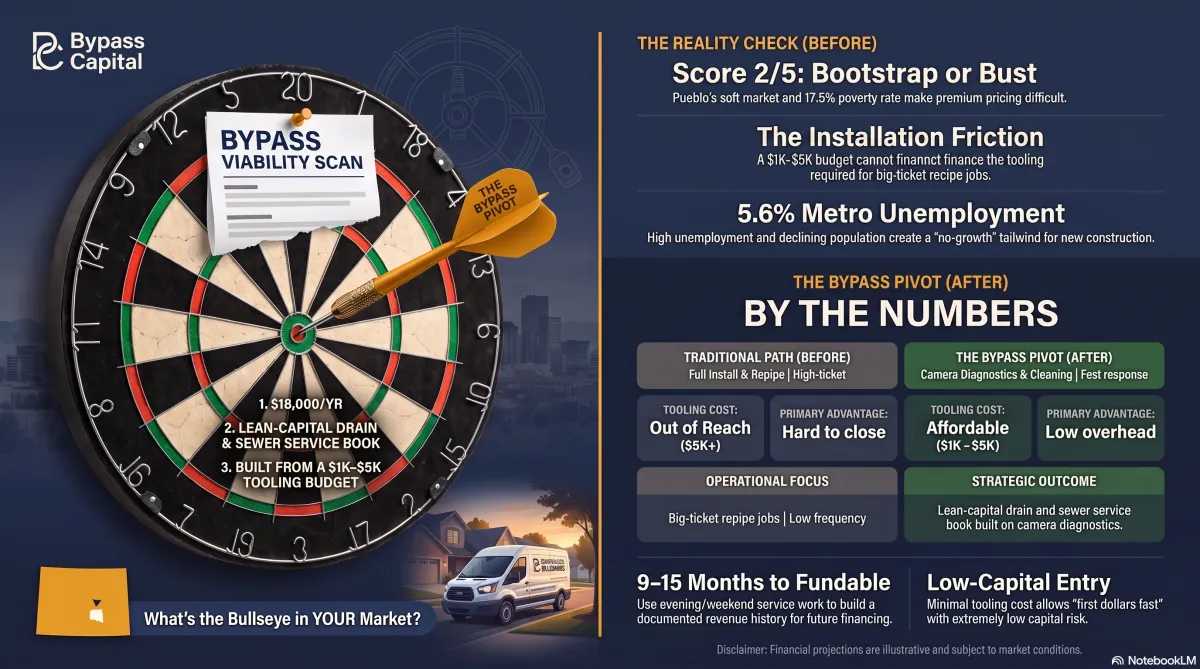
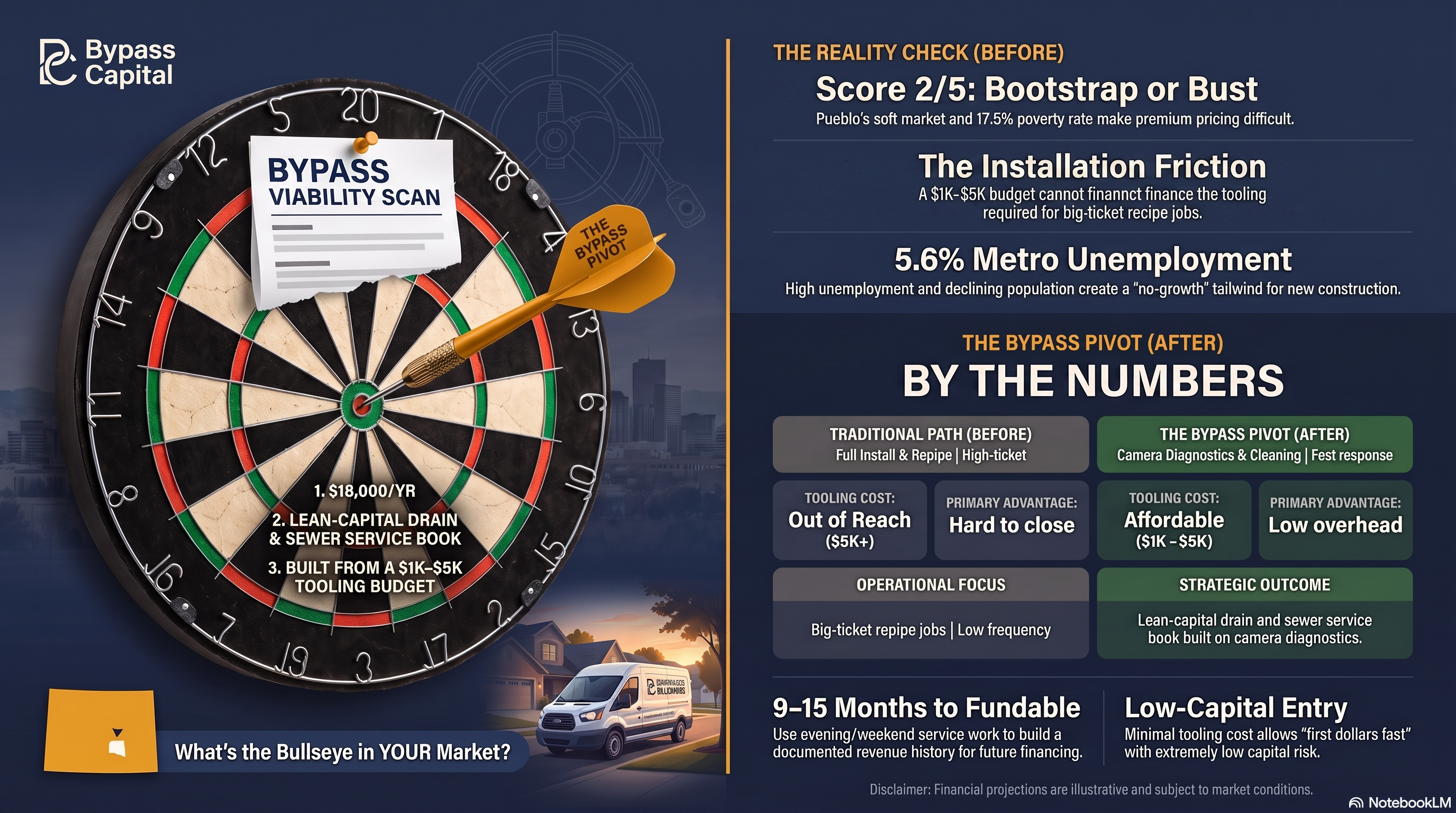
Score 2/5: Bootstrap or Bust for Dale
Pueblo's soft market and 17.5% poverty rate make premium pricing difficult.
⚠️ About This Case Study
These case studies are composite illustrations. The individuals featured are fictional and do not represent a real client. However, the market data, local opportunity, competitive landscape, pricing, and regulatory details referenced are based on real research for this trade and location. Results shown are illustrative of what the data suggests is possible — not a guarantee, promise, or projection of income. Your outcome depends on your effort, skill, capital, timing, and market conditions. Bypass Capital does not provide financial, legal, or tax advice. Always do your own due diligence and consult a qualified professional before starting or investing in any business.
Here is Dale's Deep Dive Podcast- Bypass Capital's Brutal Business Viability Scans
This is what Dale's V-Scan looked like — see what yours could show
Why a "2/5" Viability Score is the Most Profitable Reality Check Dale Ever Received
Every morning begins with the same heavy ritual. You lace up your boots, feeling the physical drag of another day spent building someone else’s equity. Your mind is a cluttered battlefield where the ambition to launch your own plumbing shop is constantly outmatched by the cold reality of a thin bank account, the exhaustion of a part-time hustle, and the haunting suspicion that your market is a dead end. You hesitate because you can feel a structural resistance in every direction, like a fighter trying to punch through water. That grinding friction isn't a lack of character—it is a result of your environment. This is exactly why the Viability Scan delivers a score of2 (Tough: Bootstrap or Bust) . This score is not a grade on your mechanical skill; it is a clinical diagnosis of the precise market headwinds and capital constraints that make your current trajectory feel like wading through mud. A $5,000 capital ceiling meeting a Tier 3 market floor creates a reality that cannot be outworked by effort alone—it must be outsmarted by strategy.
Your Market Isn't Your Enemy, It's Your Map
Think of the Pueblo geography as the fixed boundaries of the ring where this fight must be won. In a "Tier 3" market like Pueblo, CO, the data reveals a harsh structural barrier to premium pricing. The population is in a slow contraction, declining at -0.12% annually, while the 17.5% poverty rate and $56,664 median household income create a price-sensitive customer base that feels every single invoice. In this landscape, the investigative reality is clear: you aren't fighting for a piece of a growing pie; you are fighting for a stable position in a fixed, aging environment. The aging housing stock provides a documented demand floor—clogged drains and burst mains don't care about the economy—but you must size your plan to the reality of the households you serve. As the Viability Scan notes: "Dale, in a Tier 3 market this thin, the advantage is low customer-acquisition cost and word-of-mouth—but the flip side is a hard ceiling on volume and pricing. You can build a solid owner-operator living here; you are unlikely to build a fast-scaling empire."
The "80/20" Lean Pivot (Drain Cleaning over Installs)
Think of this pivot as the essential counter-punch that exploits a gap in the "Big Guy" armor. Large, established shops in Pueblo are often slow and carry high overhead, making them too expensive for a household living check-to-check. Your investigative advantage is to lean into a low-capital sub-niche: drain cleaning and sewer-scope diagnostics. The "Ticket Math" mandates this move. High-ticket installations require massive upfront costs for parts and labor that your$1,000–$ 5,000 budget cannot carry. However, that same budget can fully equip a professional drain and sewer kit. This creates a "Trust Bridge": a low-cost, high-urgency diagnostic job ( $) provides the camera evidence of failure needed to naturally upsell into high-margin sewer line repairs ($ ). By focusing 80% of your energy on these unglamorous, recession-resistant service calls, you generate immediate cash flow without the ruinous overhead of a traditional plumbing launch.
The "Corner Man" vs. The Banker
Launching a business in a price-sensitive territory is a cage match. In one corner, you have established shops with deep local roots that have held the ground for decades. In the other corner, you have the "Big Guy" outfits that dominate what little commercial work is available. Then there is the banker—who looks at your part-time status and your $5,000 budget, sees unmitigated risk, and immediately looks for the exit. This is where you need a "Corner Man" rather than a traditional lender. A corner man doesn't throw the punches for you, but they tell you the truth about when to swing and when to wait. They understand that while you are currently in the "bootstrap-and-build" band, your path to a fundable position isn't a mystery—it's a timeline. "A good corner man never shoves a fighter into the ring before he's ready. Neither do we... with a$1K–$ 5K budget and part-time status, you're in the bootstrap-and-build band. That budget doesn't finance a full-scale launch, and no honest lender will pretend it does. "The data-backed reality is a 9–15 month horizon. By using your bootstrap budget to generate documented revenue through a business account, you move from a high-risk gamble to a fundable professional. The corner man’s job is to ensure that when the bell for the next round rings, you have the paper trail necessary to finance the van and the tools the bank refused to touch.
The Discipline of the "Starting Gun"
The bell is about to ring for round one, and in a soft market, your survival depends entirely on surgical precision. Discipline isn't a virtue here; it's a mechanism to prevent overreach in a market that punishes mistakes. Your focus must remain on generating first dollars fast without quitting your primary income source prematurely. The First 7 Days: Immediate Actions
●Entity Formation: Form your LLC to legally separate your personal assets from the business.
●Business Banking: Open a dedicated account to begin the "paper trail" of documented plumbing revenue.
●Tooling Prices: Finalize quotes for the absolute minimum drain-clearing and camera-spec equipment your budget allows. The honest warning is blunt: Pueblo is a no-growth market that will punish a "fake it till you make it" approach. You must prove the revenue first and let the business earn its way to full-time status.
Conclusion: The Future of the Lean Operator
The Viability Scan isn't a generic quiz; it is a personalized map designed to help you navigate the specific pitfalls of a Tier 3 territory. While a "2/10" score may seem daunting to the uninitiated, for a strategic operator, it is the most valuable piece of intelligence you can own. It replaces blind optimism with a tactical blueprint for a lean, sustainable, and ultimately profitable service business. If you had an honest map of your market's pitfalls today, would you be brave enough to follow the narrower path to success? See what your own market report looks like at bypasscapital.com/vscan.
BYPASS CAPITAL VIABILITY SCAN
Dale | Plumbing | Pueblo, Colorado | Summer 2026
🎯 THE BYPASS VIABILITY GAUGE — SCORE: 2/5 🔴 TOUGH — BOOTSTRAP OR BUST
Territory Tier: Tier 3 — Small Market (Pueblo city pop. ~110,269; Pueblo County pop. ~168,392, down ~0.52% over the past year) · Research radius expanded to full county and broader Southern Colorado region
🚨 PIVOT RECOMMENDED: Your current path is high-friction. See the Bypass Pivot section below to find the high-margin gap in your market.
📍 SMALL MARKET ANALYSIS: This report is calibrated for a Tier 3 territory. See Section 2 for context.
Section 1 — THE VERDICT
Dale, you scored a 2 — Tough, Bootstrap or Bust — and I'm not going to soften that. Pueblo is a small, economically soft market: modest population, a county that shrank slightly over the past year, and no mega-project or population boom coming to rescue demand. You're part-time with 3 to 5 years of experience and a $1k to $5k budget, which means you're not walking into general residential plumbing and out-competing the established, decades-old shops already working this town. That's a real structural problem, not a confidence problem — and the pivot below isn't optional for you. It's the only realistic door in.
Here's the honest read: a score of 2 means the market has real limits and full-scope residential plumbing, as a standalone play, is a commodity trap here that experience alone won't solve. But there is one narrow, low-capital lane that fits your actual budget and gets you to first dollars fast — drain cleaning and sewer-scope diagnostics. It's not glamorous and it won't make you rich overnight, but it's buildable with the money you actually have, and it's the honest starting point toward the full-time business you want.
Section 2 — THE LOCAL REALITY CHECK
The Competitive Landscape
Pueblo already has established players in exactly the drain-and-sewer lane you'd be entering, so this is not an empty field: Roto-Rooter operates a branded local presence, Flow Right brings a combined 150+ years of plumbing experience and offers sewer-scope and hydrojet service, R Buck sends licensed plumbers to run camera inspections before quoting work, Patterson Plumbing & Heating runs 24/7 emergency drain service, Cut Rate Sewer & Drain Services LLC has served Pueblo since 1972, and Big Cat Plumbing, Heating & Cooling rounds out the field. Six real, active competitors in a market this size is a meaningful saturation signal — this niche will take real hustle, not just showing up.
The Demand Signal
Pueblo County's population sits around 168,392, down roughly 0.52% over the past year, and the Pueblo metro area recorded a year-over-year employment decline in 2025 while other Colorado regions posted stronger growth (World Population Review; Pueblo Economic Development Corporation). That's a real headwind — this is not a market riding a growth wave. But there's a structural, weather-independent demand floor underneath it: Pueblo sits along the mineral-rich Arkansas River, and the area's hard groundwater leaves scale buildup inside older drain lines over time, creating recurring, non-optional service need regardless of the broader economy (AmPro Inspections).
The Big Guy Weakness
Every named competitor above is either a national franchise with franchise-level pricing (Roto-Rooter) or a full-service shop where drain and sewer work is one line among many. None of them are built to compete purely on speed and price for a straightforward clog or scope job in a market where customers are watching every dollar. A lean, part-time operator with low overhead can genuinely underprice the full-service shops on the bread-and-butter jobs — that's your actual opening, narrow as it is.
Local Factors
Colorado's Residential Plumber License requires 2 years or 3,400 hours of practical experience — your 3 to 5 years already clears that bar, which is the realistic near-term credential (the full Journeyman license needs 4 years/6,800 hours, a stretch goal for later). Getting that Residential license in hand is what lets you invoice and operate independently instead of staying informal (Colorado DPO / Housecall Pro).
Section 3 — THE BYPASS PIVOT — The 80/20 Move
Dale, your pivot isn't a glamour move — it's a survival move that happens to also be the smartest use of the money you actually have. Instead of trying to compete as a general residential plumber against shops that have decades of reputation in a shrinking market, you focus narrowly on drain cleaning and sewer-scope diagnostics: the lowest-tooling-cost, fastest-to-first-dollar corner of the trade.
Positioning statement (truck-wrap ready): "Fast, Honest Drain & Sewer-Scope Service — No Big Truck, No Big Overhead, No Big Truck Prices."
Ticket math: A standard drain clear runs $100 to $300 and a sewer-scope camera inspection runs $150 to $400 (HomeGuide; Angi) — modest, but real, cash-in-hand jobs. The equipment to do this work is the part that actually fits your budget: a basic cable/drum machine plus an entry-level sewer camera together typically run somewhere in the $1,500 to $4,000 range — squarely inside your $1k to $5k startup budget, unlike the $15,000-plus rigs and inventory a full-service residential plumbing operation would require. This is the one corner of the trade where your budget and the tooling cost actually line up.
Fastest path → scale play: (1) Buy the minimum viable toolkit — one solid cable machine and one entry-level sewer camera — and nothing more until it's paying for itself; (2) get your Colorado Residential Plumber License application moving now, since you already clear the 2-year/3,400-hour bar, so you can legally invoice on your own; (3) take every straightforward drain and scope job you can get by word of mouth and document the revenue. Since your Primary Goal is a full-time plumbing business, this low-capital lane is the on-ramp — once you've got a documented track record and some cash reserve, that's when the Journeyman license and a broader service menu become realistic, not before.
Section 4 — FUNDING READINESS
Dale, picture the fight honestly. In one corner: Roto-Rooter's national name recognition. In another: Cut Rate Sewer & Drain, 50-plus years of local trust built up since 1972. Flow Right brings a combined 150 years of experience to the table. Pueblo's own soft economy and price-sensitive customers are throwing punches too. So is the Colorado licensing exam standing between you and legal independence. And so is a banker who's going to take one look at a part-time plumber with a $1k to $5k budget and ask hard questions. That's a crowded corner for someone just getting started.
Every fighter who ever won under those lights had one thing in common: a corner man. Somebody who didn't throw the punches for him, but knew the fight, patched him up between rounds, and told him the truth about when to swing and when to wait. That's what Bypass Capital is — your corner man. And a good corner man never pushes a fighter into the ring before he's ready. Neither do we.
Let's name it directly, Dale: your hurdle is Lack of Capital, and here's the honest truth about where you stand. You are not lender-ready today, and that's not a insult — it's math. Part-time employment, 3 to 5 years experience, and a $1k to $5k budget put you in bootstrap-first territory. Before any funding conversation makes real sense, you need entity formation, your Residential Plumber License, first documented revenue, and a track record that proves the drain-and-scope niche works for you specifically.
The Single Most Important Action: Submit your Colorado Residential Plumber License application. Nothing else — invoicing as a legitimate business, building a revenue trail, or having a real funding conversation later — can happen until this is in motion, and you already qualify.
Realistic Timeline: ~9–15 months to a fundable position — license in hand, minimum viable toolkit purchased and paying for itself, an LLC or sole proprietorship formed, and a documented run of drain and sewer-scope jobs behind you.
And here's the honest version of the Bypass Capital paragraph, Dale — because pitching you funding today would be the wrong move: right now, the work is proving the pivot, not raising capital. Bypass Capital works differently than a traditional lender when the time comes — approval rates are higher, the process moves in days not months, the paperwork won't bury you, and there are funding options built for startup operators a bank can't match. But that conversation is for after you've built the foundation, not instead of it. When your license, your entity, and your documented track record are in place, we're the corner that gets you moving faster than any bank would allow.
When you're ready to step into your corner, it starts with a standard application — it tells us where you stand and what you need, so the conversation opens with real answers, not guesswork. Apply here: [APPLICATION LINK]
Section 5 — THE NEXT MOVE
This is not a summary. This is a starting gun.
The One Action (next 7 days): Submit your Colorado Residential Plumber License application through the Colorado Division of Professions and Occupations (DPO) — you already meet the 2-year/3,400-hour experience minimum. This is the single legal unlock that lets you invoice independently and start building a real track record.
The 30 Day Marker: Thirty days from now you should have your license application submitted, a basic cable machine and entry-level sewer camera purchased within your budget, and two or three word-of-mouth drain or scope jobs completed and documented.
The Honest Warning: Dale, if you keep working this part-time and informal, with no license and no documented revenue, you'll still be exactly where you are a year from now — and Pueblo's soft economy won't hand you a break you didn't build yourself. The bootstrap path is narrow, but it's real. Staying undefined is the only way to actually lose.
Sources: World Population Review, Pueblo city and county 2026 population data; Pueblo Economic Development Corporation (PEDCO) dashboard; Roto-Rooter, Flow Right, R Buck, Patterson Plumbing & Heating, Cut Rate Sewer & Drain Services, and Big Cat Plumbing company listings; Colorado Division of Professions and Occupations (DPO) plumbing license requirements via Housecall Pro and RocketCert; HomeGuide and Angi drain cleaning and sewer camera inspection cost guides; AmPro Inspections on Southern Colorado groundwater and sewer-scope demand; VEVOR and HomeTips sewer camera equipment cost guides.
Here is Dale's Slide Deck - The Bypass Pivot
What's the Bullseye in your market? Take the free V-Scan → bypasscapital.com/vscan.
Additional Plumbing Case Studies
→Priya had the plumbing skills — what she was missing was the business behind them. See the fix →