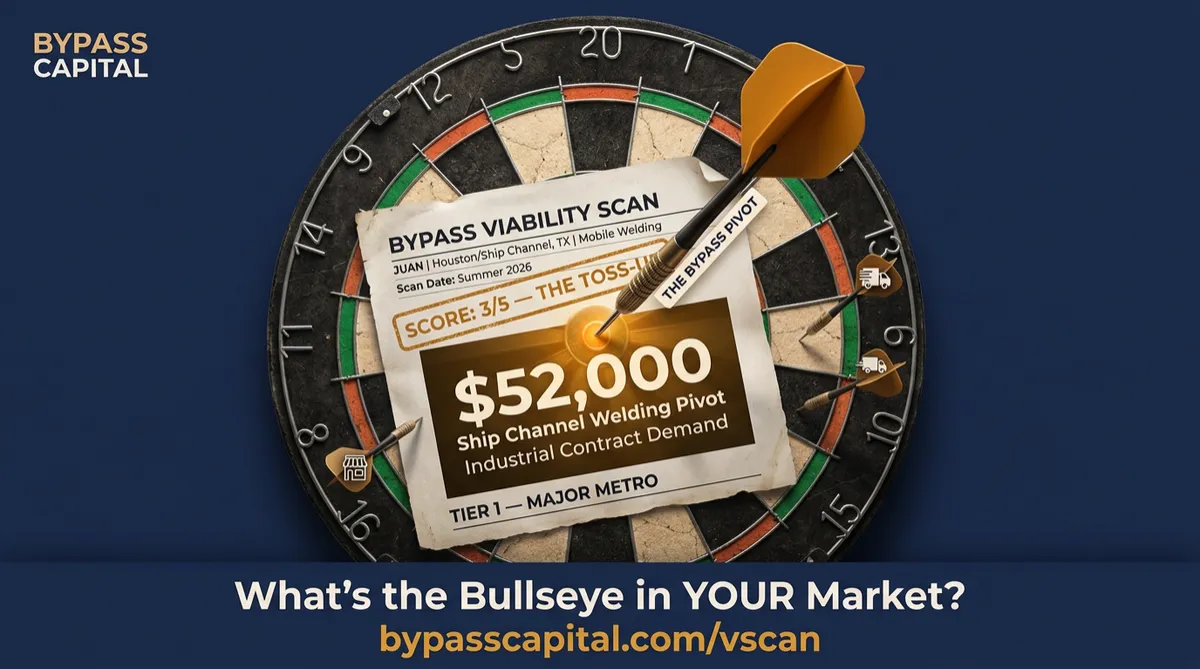
Why Houston is a _Toss-Up_ for Mobile Welders_ The 80_20 Strategy for Dominating the Energy Capital
The Houston Welding Bullseye:
Escaping the Commodity Trap
⚠️ About This Case Study
These case studies are composite illustrations. The individuals featured are fictional and do not represent a real client. However, the market data, local opportunity, competitive landscape, pricing, and regulatory details referenced are based on real research for this trade and location. Results shown are illustrative of what the data suggests is possible — not a guarantee, promise, or projection of income. Your outcome depends on your effort, skill, capital, timing, and market conditions. Bypass Capital does not provide financial, legal, or tax advice. Always do your own due diligence and consult a qualified professional before starting or investing in any business.
Here is the Deep Dive Podcast for Juan - Houston Welding Strategic Market Analysis
Below you can see what Juan's V-Scan looks like — see what yours could show
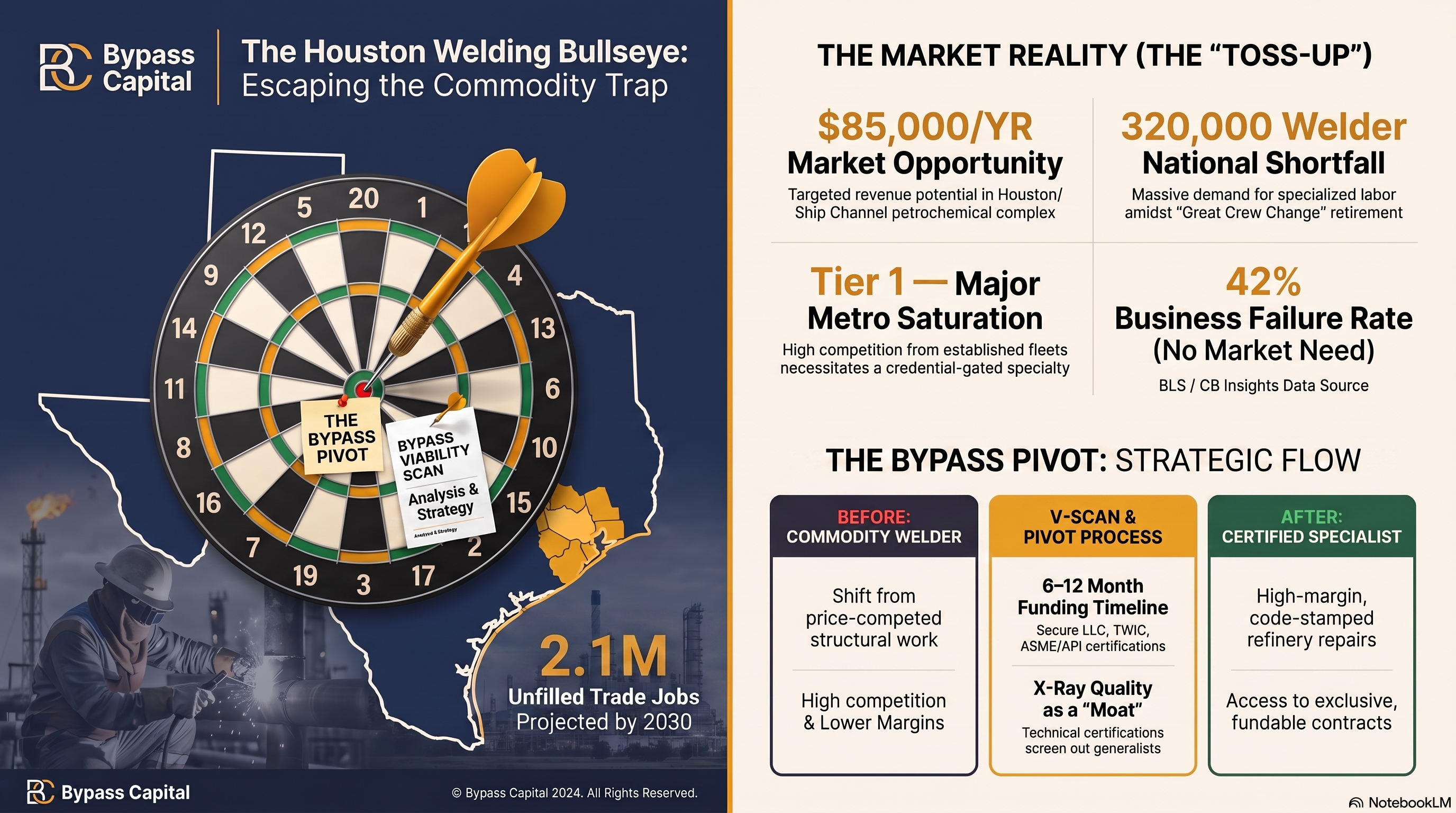
Why Houston is a "Toss-Up" for Mobile Welders: The 80/20 Strategy for Dominating the Energy Capital
Houston is the undisputed heavy-weight champion of the energy world. It is home to the Houston Ship Channel—the largest petrochemical complex in the United States—featuring a 52-mile waterway and over 200 industrial terminals. Texas refineries alone process more than 30% of the nation’s crude capacity, and with LNG exports projected to hit 18.1 Bcf/d by 2027, the demand for maintenance is relentless. Yet, for a new mobile welding operation, this market is a paradox. Despite the staggering volume of work, Houston currently carries a viability rating of3/5—a "Toss-Up. "For the independent operator, the city isn't just a market; it’s a cage match. If you step into the ring as "just another guy with a truck," you aren't just competing for work; you’re drowning in a sea of saturation. To survive the energy capital, you have to stop fighting for scraps and start building a moat.
The "Commodity Trap" in the World’s Largest Petrochemical Complex
While Houston is a Tier 1 Metro with world-class demand signals, it is also home to a deeply professionalized and crowded field. Established outfits like WeldIT field entire fleets of ASME- and API-certified rigs, offering 24/7 turnaround support to heavyweights like Motiva Port Arthur (654K bpd) and ExxonMobil Baytown (560K bpd). "Walk in as a commodity mobile welder and you're one of hundreds." In this landscape, simply owning a rig is no longer a competitive advantage; it’s the bare minimum. When you compete on general structural work or basic repairs, you are bidding against a massive crowd on price alone. This "commodity trap" leads to razor-thin margins and a race to the bottom against fleet-scale competitors who can out-wait and out-price you every time.
The "Great Crew Change" is Your Secret Weapon
The path out of the commodity trap lies in a massive demographic shift hitting the Gulf Coast. The energy sector is currently facing "The Great Crew Change," where 2.4 workers are nearing retirement for every single entrant under the age of 25. According to the CEWD/AWS 2025 report , the industry faces a national shortfall of 320,000 welders by 2029. In the Houston corridor, the deficit is most acute among high-pressure and high-alloy pipe welders—roles that are currently named among the hardest to fill. This isn't just a labor shortage; it is a specialist’s opening. Facilities are desperate for hands who can actually pass the code on chrome-moly and exotic alloys, making expertise the only real currency in a saturated market.
The 80/20 Pivot: Escaping the Price War
To move from a "Toss-Up" to a dominant position, you must execute the "Bypass Pivot." This strategy focuses on the 20% of work that requires high-level credentials, leaving the other 80% of the crowd to fight over low-margin structural jobs. With a typical startup budget of$5K–$ 25K, the most capital-efficient move is not trying to out-price a fleet, but funding the certifications that the commodity crowd can’t punch.
●The Commodity Path: Bidding on general structural and basic repair. You win on price, lose on margin, and stay replaceable.
●The Specialist Path: Focusing on ASME Section IX pressure piping, API 1104 tie-ins, and AWS D1.1 structural code work. This path leads to X-ray-quality turnaround work that pays a premium because it is a requirement, not a preference. By focusing your budget on your ASME/API certs and rig outfitting for code work, you transform from a general laborer into a critical asset.
Barriers are Actually Moats
In the Ship Channel, the hurdles to entry are high, but for the professional, these barriers are actually protective moats. "Access itself is a moat... those barriers thin the field to credentialed operators." Securing a TWIC card for port access and maintaining HASC (Health and Safety Council) compliance are basic entry requirements. However, the true "moat" is the administrative discipline required for Welder Continuity and PQR (Procedure Qualification Record) paperwork . Most "guys with a truck" lack the organizational rigor to maintain documented X-ray-pass records. By mastering the paperwork as well as the puddle, you thin the field to a select group of credentialed operators that Tier 1 facilities can actually trust.
The "Corner Man" Philosophy
In a city where every morning starts like a cage match against fleet-saturated metros and code inspectors who reject anything short of perfection, you need more than just a bank—you need a "corner man." A corner man doesn't throw the punches for you, but they know the fight, they patch you up, and they ensure you don't enter the ring until you're ready.This is the role of a strategic partner like Bypass Capital. In a market where your hurdle is competition rather than just capital, a "corner man" helps you transition from a "guy with a truck" to a fundable, credentialed business.
The Strategy for the Next 30 Days:
The 7-Day Sprint: Stop pitching "welding." Identify three specific turnaround contractors or facility maintenance managers on the Ship Channel and pitch your services specifically for code-stamped pressure and pipe repair.
The 30-Day Marker: Form your LLC and establish a dedicated business banking account. Run your first code-stamped repair job through this account to build the "documented revenue trail" that lenders—and major facilities—demand. In a city full of rigs, are you building a commodity job, or are you building a credentialed asset that the energy industry can't afford to lose? Your 5+ years of experience is the foundation, but your certifications are the ticket to the high-margin work the Houston market is starving for.
🔧 Bypass Viability Report — Juan · Mobile Welding · Houston, TX
🟡 THE BYPASS VIABILITY GAUGE: 3 / 5 — "The Toss-Up"
📍 Territory Tier: Tier 1 — Major Metro (Houston / Ship Channel, largest US petrochemical complex)
🚨 PIVOT RECOMMENDED: Enormous demand, crowded field. Your edge is code certification. See The Bypass Pivot.
Section 1 — THE VERDICT
Juan, this is a 3 — a classic Toss-Up where the demand is world-class and so is the competition. Houston is the energy capital of the country: the Ship Channel is the largest petrochemical complex in the US with 200+ terminals across a 52-mile waterway, Texas refineries process 30%+ of national crude capacity, and LNG exports are climbing from 15 to a projected 18.1 Bcf/d by 2027 — all of it feeding constant refinery turnarounds and pressure-piping demand (AWSCWI, 2026). But here's the flip side: Houston is saturated with mobile welders. Established outfits like WeldIT field entire fleets of ASME- and API-certified rigs marketing 24/7 turnaround support (WeldIT, 2026). Walk in as a commodity mobile welder and you're one of hundreds. You've got 5+ years and a $5K–$25K budget — enough to escape the pack, but only if you specialize up into code-stamped work. That's the 3, and the pivot is the whole game.
Section 2 — THE LOCAL REALITY CHECK
The Competitive Landscape. Deep and professionalized. The top tier — WeldIT and peers — run self-contained 4×4 rigs, hold ASME Section IX, API 1104, and AWS D1.1 certs, carry TWIC cards for port access, and market X-ray-quality, HASC-compliant turnaround crews (WeldIT). Commodity structural and repair welders are everywhere. If you compete on "I can weld and I have a truck," you're bidding against a crowd on price and losing margin.
The Demand Signal. (1) Relentless refinery turnaround season — Motiva Port Arthur (654K bpd), ExxonMobil Baytown (560K bpd), and the whole corridor run intensive, deadline-driven turnarounds requiring code-piping welders (regional, AWSCWI). (2) The Great Crew Change — 2.4 energy workers near retirement for every entrant under 25, with high-pressure and high-alloy pipe welders named among the hardest roles to fill in Houston (Clayton Personnel, 2026). (3) The LNG/petrochemical build-out — Golden Pass, expansions, and a national projected shortfall of 320,000 welders by 2029 (CEWD/AWS, 2025).
The Big Guy Weakness. The volume mobile-welding shops chase broad structural and general repair work. The gap — and the one your 5+ years can fill — is certified, code-stamped repair and pressure welding: ASME Section IX pressure piping, API 1104 tie-ins, X-ray-quality turnaround work on chrome-moly and exotic alloys. That work screens out generalists by requirement, not preference, and the crew-change shortage means facilities are desperate for hands who can actually pass the code.
Local Factors. Access itself is a moat: TWIC cards, HASC compliance, and documented welder continuity/PQR paperwork are required to even set foot in a Ship Channel facility. Those barriers thin the field to credentialed operators — which is exactly why the specialist wins.
Section 3 — THE BYPASS PIVOT — The 80/20 Move
Juan, your Competition hurdle breaks the moment you stop being "mobile welder with a truck" and become the certified, code-stamped repair specialist the turnaround and LNG world is short of. Your 5+ years is the foundation; the certifications are the ticket the commodity crowd can't punch.
Positioning statement: "Houston's code-certified field repair welder — ASME and API pressure work that passes X-ray the first time."
The certification math:
Commodity path: bid general structural and repair against hundreds of rigs, win on price, bleed margin.
Specialist path: get (or document) your ASME Section IX / API 1104 certs, TWIC card, and HASC compliance, then target refinery turnarounds, pressure-piping repair, and LNG tie-in work — higher margin, credential-gated, and starving for hands thanks to the crew change. Your $5K–$25K budget covers certs, TWIC, and rig outfitting rather than trying to out-price a fleet.
Fastest path to first revenue → scale: Your goal is a full-time mobile welding business and your hurdle is competition, so lead with your certifications to the turnaround contractors and facility maintenance managers who can't find enough code welders. Land credentialed repair work first, build a documented X-ray-pass track record, then scale as the retirement wave widens the gap.
The 80/20 truth: The crowd is fighting over the 80% of commodity structural work. The 20% — certified, code-stamped pressure and turnaround repair — is where the margin lives, where the crew change guarantees demand, and where your experience makes you one of a scarce few instead of one of hundreds.
Section 4 — FUNDING READINESS
Juan, picture how your morning really starts. You lace up your boots and step into a cage match — and in Houston the ring is packed with fleets of certified rigs before you've even thrown a punch. In the corners: outfits like WeldIT with 24/7 fleets and full cert stacks, facility managers squeezing every bid on price, the Gulf Coast heat and TWIC-gated access, code inspectors who reject anything short of X-ray quality, and a banker weighing a $5K–$25K budget against a metro full of established competitors. Six opponents deep, every day. That's the job.
Every fighter who ever won under those lights had one thing in common: a corner man. Somebody who didn't throw the punches for him, but knew the fight, patched him up between rounds, and told him the truth about when to swing and when to wait. That's what Bypass Capital is — your corner man. And a good corner man never pushes a fighter into the ring before he's ready. Neither do we.
Your hurdle is Competition, not capital — but let's be honest about your position. At 5+ years, still employed, with a $5K–$25K budget, you're in the certify-and-document band. The skill is there; what a lender needs to see is the LLC, the code certifications and TWIC in your own name, and documented specialized revenue that proves you win the code-stamped work, not the commodity work.
The Single Most Important Action: Form your LLC and lock in your ASME/API certifications and TWIC now, then run your first code-stamped repair job through a dedicated business account — documented X-ray-pass revenue is what separates you from the hundreds of commodity rigs in a lender's eyes.
Realistic Timeline: ~6–12 months to a fundable position — entity, certs, and TWIC squared, clean business banking, and a documented stack of code-stamped repair work you can point to.
And here's why the corner man matters when the bell finally rings, Juan. Bypass Capital works differently than a traditional lender: approval rates are higher, the process moves in days not months, the paperwork won't bury you, and there are funding options built for startup operators a bank can't match. Once your entity and specialized revenue trail are in place, we're the corner that funds your rig upgrade and working capital faster than any bank would allow.
Next step: When you're ready to step into your corner, it starts with a standard application — it tells us where you stand and what you need, so the conversation opens with real answers, not guesswork. Apply here: [APPLICATION LINK]
Section 5 — THE NEXT MOVE
The One Action (next 7 days): Identify the three turnaround contractors or facility maintenance managers on the Ship Channel and pitch your crew specifically for code-stamped pressure/pipe repair — not general structural. That's your escape from the pack.
The 30-Day Marker: 30 days out you should have your LLC formed, certs and TWIC in the business name, and at least one code-stamped repair bid or conversation in motion.
The Honest Warning: Juan, if you launch as one more commodity mobile welder in a fleet-saturated metro, you'll drown on price — the only version that works is the certified specialist version, so plant that flag from day one.
Some other Case Studies that may interest you.
→How a part-time Permian Basin welder builds toward a rig without going into debt for one →
→A federal mandate, a thin field, and a Farmington HVAC tech racing to claim the gap →