Jack's Story — The Market Gap
The Farmington HVAC Market Gap:
Jack's High Growth Pivot.
⚠️ About This Case Study
These case studies are composite illustrations. The individuals featured are fictional and do not represent a real client. However, the market data, local opportunity, competitive landscape, pricing, and regulatory details referenced are based on real research for this trade and location. Results shown are illustrative of what the data suggests is possible — not a guarantee, promise, or projection of income. Your outcome depends on your effort, skill, capital, timing, and market conditions. Bypass Capital does not provide financial, legal, or tax advice. Always do your own due diligence and consult a qualified professional before starting or investing in any business.
The Deep Dive Podcast-CS 19 Capturing the Farmington HVAC market gap
Further down this post you'll find what Jack's V-Scan looked like — see what yours could show
The Blue Ocean in the High Desert: Why HVAC’s ‘Old Guard’ is Leaving Money on the Table
1. Introduction: The Hidden Opportunity in "Boring" Markets
Starting a trade business in a mid-size market like Farmington, New Mexico, isn't a soft launch—it’s a cage match. You aren’t just battling competitors; you’re fighting 100-degree high-desert cooling loads, dual-season demand that spikes in both summer and winter, and a brutal 50-mile service radius. However, for the entrepreneur who can see past the dust, there is a legitimate "4/5" rated market gap in the Four Corners region. With a regional population of approximately 121,000 in San Juan County, this isn't a small-town play—it’s a massive infrastructure turnover. While metropolitan operators are cannibalizing each other in over-saturated cities, the Four Corners is starving for modern, high-efficiency service. The opportunity is real, but the hurdle is sequencing: your budget is lean ( $1K–$ 5K), and your primary opponent is Time.
2. Takeaway 1: Your Competitors are Living in 1952 (And That’s Your Edge)
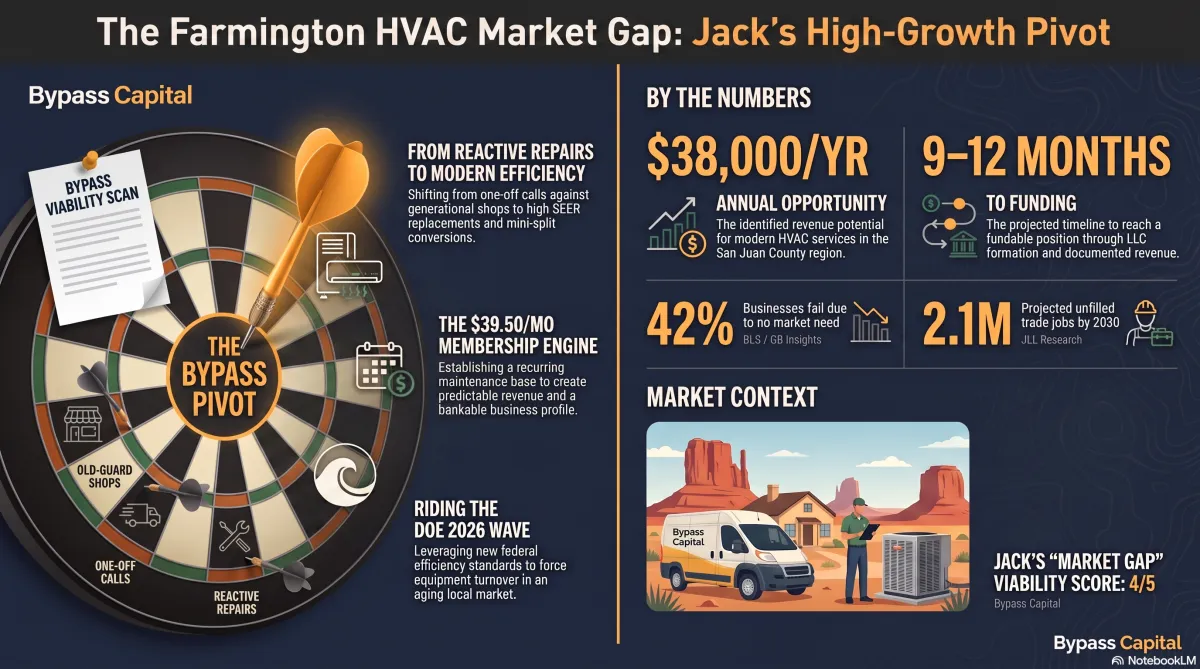
The Farmington HVAC landscape is defined by longevity, not agility. The market is held by the "Old Guard": Farmington Heating & Metal (est. 1952), Anderson Air Corps (est. 1961), General Hydronics (est. 1984), and R.A. Biel Plumbing & Heating (est. 1988). While these names carry trust, they operate at a "generational" pace. The industry analyst’s view reveals two massive vulnerabilities in these incumbents. First, the local commercial capacity is incredibly thin. Current data shows a pipeline of 51 HVAC construction projects averaging 27,000 sq. ft., yet response times for bids average a sluggish three days. Second, the heavy-hitting commercial competition is 250–290 miles away in Phoenix or Denver. This distance creates a natural geographic moat. Furthermore, the New Mexico state mechanical licensing requirement acts as a barrier to entry, keeping out fly-by-night "handymen" and protecting professional operators who can navigate the RLD Construction Industries Division."Farmington is a mid-size Four Corners market with real desert-heat cooling load, an aging equipment base, and a competitive field that's thin and old-guard rather than saturated."
3. Takeaway 2: The Regulatory Wave as a Business Windfall
Turning Efficiency Standards into a Market Moat The DOE 2026 efficiency-standard changeover is the single largest catalyst for revenue in the next decade. While legacy shops view these mandates as a headache or a hurdle, a strategist sees them as a "reason to knock on every door." The Four Corners has an aging installed base that must now be replaced with high-SEER systems. The "80/20 move" here is simple: while the old-guard shops are too "comfortable" chasing the 80% of familiar, low-margin repair work, you must sprint toward the 20% of high-efficiency replacement and ductless mini-split conversions. Riding this wave allows you to pivot from a repairman to a high-ticket consultant.
4. Takeaway 3: Small-Town Geography is the Ultimate Marketing Moat
In metros like Atlanta or Bakersfield, your Customer Acquisition Cost (CAC) is dictated by Google Ad bidding wars. In San Juan County, the "Small Market Advantage" means word-of-mouth is your marketing budget. When you provide modern, reliable service in a territory where the incumbents take three days just to answer a bid, the referral engine moves faster than any digital campaign.
"Being small here isn't a weakness — it's the moat."
By dominating a 30–50 mile radius, you lock in reliability and pricing power. You aren't competing with the world; you are competing with a handful of shops that have been doing things "the old way" since the mid-20th century.
5. Takeaway 4: The $39.50 "Bridge" to Freedom
To move from a lean-budget startup ( $1K–$ 5K) to a fundable enterprise, you must abandon the commodity mindset. R.A. Biel has already validated the market's hunger for recurring revenue with their $39.50/month service agreements. Copying this proven local playbook is the fastest path to bridge your income.
●The Commodity Path: Chasing one-off repair calls against companies that have owned local trust since 1952.
●The Gap Path (The Strategist's Choice):Leading with high-SEER replacements and locking every customer into a $39.50/month maintenance plan. This creates the documented, predictable revenue that traditional banks ignore but specialized lenders crave.
6. Takeaway 5: Why Your "Corner Man" Matters More Than Your Bank
Traditional banks struggle to fund trade operators with lean budgets and 3–5 years of experience. They see risk where we see "ring conditioning." This is where Bypass Capital serves as your "corner man." We aren't interested in pushing you into the ring before you're ready; we focus on the foundational work—entity formation, licensing, and establishing your first few maintenance contracts. A corner man knows that speed-to-market requires higher approval rates and funding that moves in days, not months. We handle the "patching up" between rounds so you can focus on the fight. "Somebody who didn't throw the punches, but knew the fight... patched him up between rounds, and told him the truth about when to swing and when to wait."
7. Conclusion: The Clock is Ticking in the Four Corners
This 4/5-rated opportunity is not a permanent fixture; it has a shelf life. The DOE turnover wave and the thin local field represent an open door that will eventually be filled by hungrier, younger operators. Your timeline to reach a fully fundable position is 9–12 months. To stay on track, your One Action for the next seven days is to draft a one-page monthly maintenance offer—using the $39.50 benchmark—and pitch it to five homeowners with aging systems. The 30-Day Marker: By day 30, you must have your LLC formed and either two maintenance-plan members or one high-efficiency replacement booked. This is the proof the gap is yours. Are you going to keep chasing the 80% of familiar repair work, or are you ready to own the high-efficiency future of the desert?
Here is Jack's Full V-Scan Report
🌡️ Bypass Viability Report — Jack · HVAC · Farmington, NM
🔵 THE BYPASS VIABILITY GAUGE: 4 / 5 — "The Market Gap"
📍 Territory Tier: Tier 2 — Mid-Size Market (Farmington / San Juan County, pop. ~46K city / ~121K county — research radius expanded to the Four Corners region)
✅ FULL THROTTLE: You've found a legitimate gap. Focus on speed-to-market and building your bank-ready profile immediately.
Section 1 — THE VERDICT
Jack, this one earns a 4, and I don't hand those out casually. Farmington is a mid-size Four Corners market with real desert-heat cooling load, an aging equipment base, and a competitive field that's thin and old-guard rather than saturated — the local names have been around since 1952, 1961, 1988 (Porch, 2026; Downtobid, 2026). That combination — steady demand, few modern operators, a turnover wave forced by efficiency standards — is a genuine market gap. The one thing standing between you and a 5 is you: your hurdle is Time and your budget is lean ($1K–$5K), so this is a sequencing-and-speed problem, not an opportunity problem. Tier 2 note: some data below is county/regional rather than hyper-local; I've flagged it, and it means your due-diligence burden is a little higher, not lower.
Section 2 — THE LOCAL REALITY CHECK
The Competitive Landscape. Thin and long-established. Directories count roughly 50 HVAC-tagged companies across the Farmington area, but the credible local core is small and generational — R.A. Biel Plumbing & Heating (est. 1988, NATE-certified, Carrier dealer), Anderson Air Corps (est. 1961), Farmington Heating & Metal (est. 1952), General Hydronics (est. 1984), plus B&D and Comfort Solutions Mechanical (Porch; Downtobid) (local/regional). Most "commercial" competition on bid platforms is 250–290 miles away in Phoenix or Denver — meaning true local capacity is limited (regional, Downtobid).
The Demand Signal. (1) High-desert cooling + real heating load across ~121K San Juan County residents — dual-season demand, not seasonal (regional). (2) The DOE 2026 efficiency-standard changeover is forcing equipment turnover exactly as the region's older installed base ages out (national → local relevance). (3) Active commercial pipeline: one platform tracked 51 HVAC construction projects in the area averaging ~27,000 sq ft, with response times averaging 3 days and local capacity thin (Downtobid) (regional).
The Big Guy Weakness. The established locals are exactly that — established and old-guard. Incumbents like R.A. Biel already prove the recurring-revenue model works here (their $39.50/month service-agreement membership is right on the website), which validates demand but also shows how few operators are aggressively modern about it. The gap: a younger, high-efficiency-focused operator who moves fast on the DOE-driven replacement wave and ductless mini-split conversions — while the generational shops run at a comfortable, slower pace.
Local Factors. New Mexico requires state mechanical licensing (RLD Construction Industries — permits at rld.nm.gov) and HVAC permits for install/alteration — a barrier that keeps the field credible and thin. The Four Corners service geography (30–50 mile radius) rewards whoever locks in reliability first.
Small Market Advantage. Jack, this is the part the metro guys never get to enjoy. In a thin Four Corners market, word of mouth is your marketing budget — a handful of well-served customers in San Juan County becomes a referral engine no ad spend can buy. Customer acquisition costs are a fraction of Bakersfield or Atlanta, you have real pricing power as one of the few modern credible operators, and the DOE turnover wave hands you a reason to knock on every aging-system door in the region. Being small here isn't a weakness — it's the moat.
Section 3 — THE BYPASS PIVOT — The 80/20 Move
Jack, at a 4 this isn't a trade redirect — it's a positioning and speed play. You don't need to become something else; you need to own the high-efficiency replacement + recurring maintenance lane before another young operator wakes up to it.
Positioning statement for the truck/site: "The Four Corners' high-efficiency HVAC pro — modern systems, honest service, and a maintenance plan that keeps you covered year-round."
The niche math:
Commodity path: chasing one-off repair calls against shops that have owned local trust since 1952.
Gap path: ride the DOE 2026 efficiency turnover with high-SEER replacements and ductless mini-split conversions (higher ticket, less competition), and copy the proven local playbook with your own recurring monthly maintenance membership — R.A. Biel's $39.50/month model shows this market already buys it. Recurring revenue is what makes this bankable and, eventually, sellable.
Fastest path to first revenue → scale: Your hurdle is Time and budget is lean, so sequence it like Denise's play. Stay employed, land your first replacement jobs and maintenance-plan sign-ups on nights/weekends through word of mouth, and let that recurring base become your bridge income. When the monthly-contract revenue covers your nut, you jump — and scale the membership book across the Four Corners radius.
The 80/20 truth: The old-guard shops are too comfortable chasing the 80% of familiar repair work to sprint at the 20% high-efficiency replacement wave that's landing right now — that speed gap is your whole opportunity.
Section 4 — FUNDING READINESS
Jack, picture how a Four Corners HVAC operator's morning really starts. You lace up your boots and step into a cage match — but out here you're not just fighting competitors, you're fighting the clock and the map. In the other corners: shops that have owned this town's trust since 1952, the desert heat spiking every call at once, the 40-mile drive between jobs eating your day, a supplier passing along DOE-transition equipment costs, the NM licensing board, and a banker looking at a lean $1K–$5K budget and a still-employed applicant. Half a dozen opponents before you've swung once. That's the job.
Every fighter who won under those lights had one thing in common: a corner man. Somebody who didn't throw the punches, but knew the fight, patched him up between rounds, and told him the truth about when to swing and when to wait. That's what Bypass Capital is — your corner man. And a good corner man never pushes a fighter into the ring before he's ready. Neither do we.
Your hurdle is Time, not capital — but with a $1K–$5K budget and 3–5 years in, you're in the bootstrap-first band. Entity formation, first documented revenue, and a real track record come before any serious funding conversation makes sense. That's not a knock, Jack — it's ring conditioning. You've got a genuine 4-rated market gap; you just need the paper to prove you can capture it.
The Single Most Important Action: Form your LLC and launch a simple recurring maintenance-plan offer now, so your very first membership sign-ups create documented, predictable revenue — the single strongest thing a lean-budget operator can put on paper.
Realistic Timeline: ~9–12 months to a fundable position — LLC formed, NM licensing squared, a handful of high-efficiency replacements booked, and a growing monthly-membership base that shows recurring revenue.
And here's why the corner man matters when the bell finally rings, Jack. Bypass Capital works differently than a traditional lender: approval rates are higher, the process moves in days not months, the paperwork won't bury you, and there are funding options built for startup operators that a bank flat-out can't match. Once your entity and that recurring-revenue base are in place, we're the corner that gets you off payroll and scaling faster than any bank would allow.
Next step: When you're ready to step into your corner, it starts with a standard application — it tells us where you stand and what you need, so the conversation opens with real answers, not guesswork. Apply here: [APPLICATION LINK]
Section 5 — THE NEXT MOVE
The One Action (next 7 days): Draft a one-page monthly maintenance-plan offer (price it against R.A. Biel's $39.50/month benchmark) and pitch it to the first five aging-system homeowners in your network — that's your recurring-revenue engine and your bridge income in one move.
The 30-Day Marker: 30 days out you should have your LLC formed and at least two maintenance-plan members or one high-efficiency replacement booked — proof the gap is real and yours.
The Honest Warning: Jack, this 4 has a shelf life — the DOE turnover wave and the thin local field are an open door right now, but if you let the Time hurdle stall you a year, a hungrier young operator walks through it first.
Get the complete picture behind Jack's 4-out-of-5 score — the DOE 2026 mandate, the thin Farmington competitive field, and the sequencing plan that beats the clock.
Check out Jack's complete Slide Deck here- Farmington_HVAC_Market_Gap
What's the Bullseye in your market? Take the free V-Scan → bypasscapital.com/vscan.
Here are some additional V-Scan Case Studies for HVAC
→How an Atlanta HVAC tech built a bridge off payroll without quitting her day job first →
→Why a Bakersfield HVAC tech stopped chasing $385 repairs and started chasing Title 24 retrofits →