The Capital Canyon_ Why Your Industrial Business Dream Needs a Bridge, Not a Leap
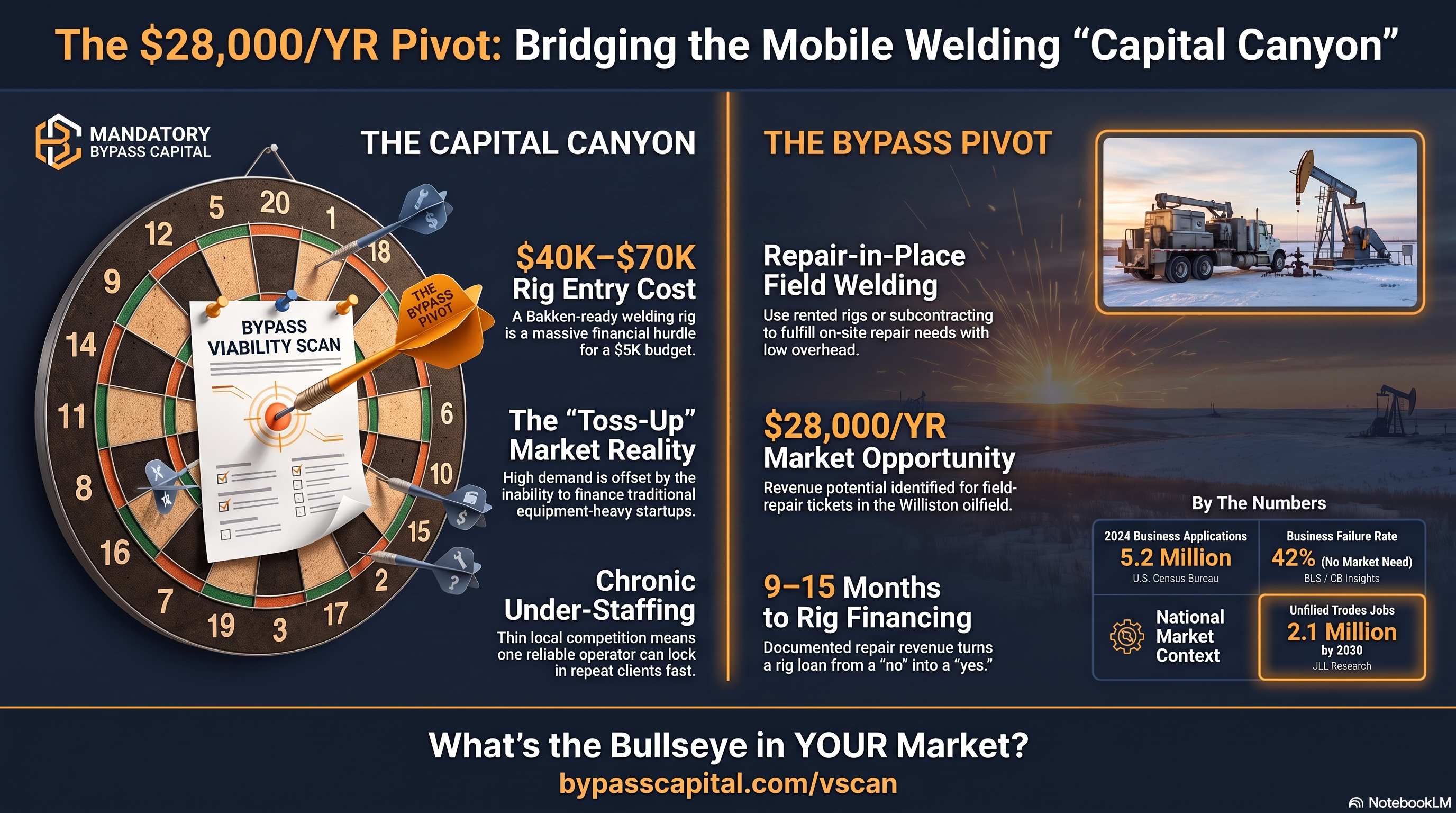
The $28,000/YR Pivot:
Bridging the Mobile Welding "Capital Canyon"
⚠️ About This Case Study
These case studies are composite illustrations. The individuals featured are fictional and do not represent a real client. However, the market data, local opportunity, competitive landscape, pricing, and regulatory details referenced are based on real research for this trade and location. Results shown are illustrative of what the data suggests is possible — not a guarantee, promise, or projection of income. Your outcome depends on your effort, skill, capital, timing, and market conditions. Bypass Capital does not provide financial, legal, or tax advice. Always do your own due diligence and consult a qualified professional before starting or investing in any business.
Here is the Deep Dive Podcast for Cody - Starting an oilfield welding business without capital
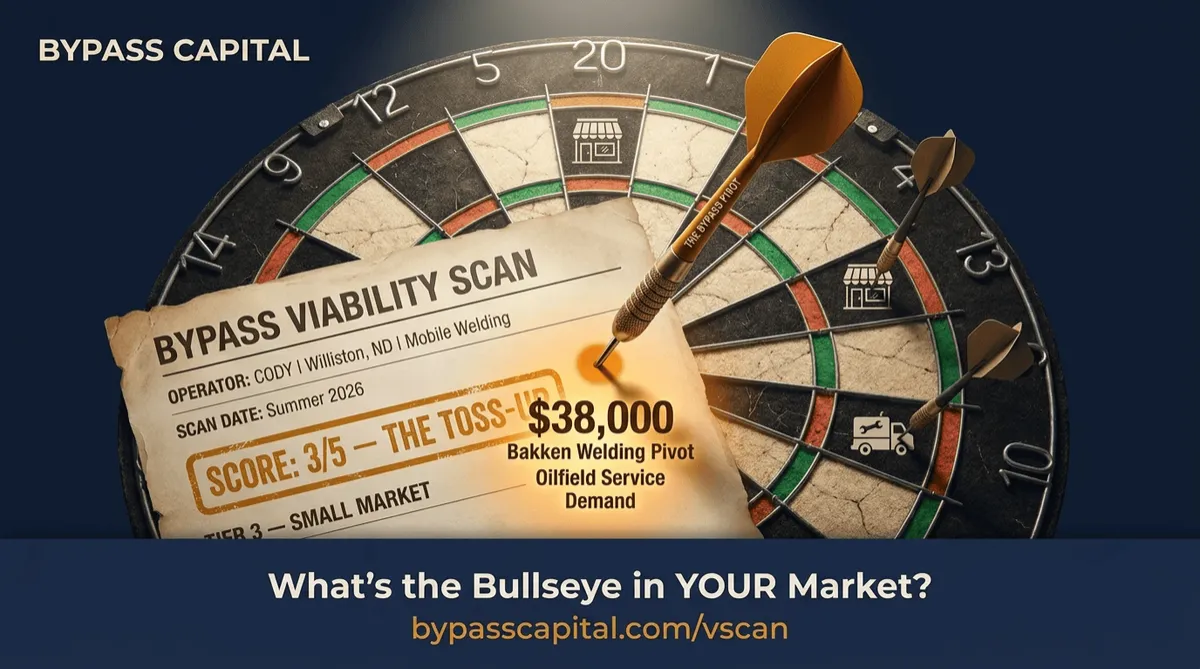
Below you can see what Cody's V-Scan looks like — see what yours could show
The Capital Canyon: Why Your Industrial Business Dream Needs a Bridge, Not a Leap
The Bakken Paradox
Williston, North Dakota, isn’t just a location on a map; it is the epicenter of a high-stakes industrial boom. In the Bakken Formation, the work is heavy, the stakes are higher, and the demand for skilled hands is relentless. But here is the reality check: every morning you wake up in the Bakken, you aren't just starting a workday—you are stepping into a cage match. Your opponents are the country, the brutal North Dakota cold, and a cost of entry that floors most entrepreneurs before the first arc is struck. The "Bakken Paradox" is simple: the region is starving for industrial welding—pipe welding, wellhead fabrication, and structural repair—yet the very equipment required to do the job creates a "capital canyon" that swallows dreams whole. To survive here, you have to stop thinking about a "leap" and start building a strategic bridge.
Takeaway 1: The "Capital Canyon" is a Business Killer
In this game, the barrier to entry is the rig. The math is brutal: you are likely looking at a startup budget of $1,000 to $5,000, while a Bakken-ready welding truck costs between $40,000 and $70,000. That gap is the capital canyon .Most welders chase the "fantasy path." They try to buy a rig they can't afford or piece together a subpar setup that will inevitably fail when the mercury hits twenty below. Chasing that fantasy doesn't just slow you down—it stalls you at the gate and destroys your professional reputation. "Fantasy path: try to buy a$40K–$ 70K Bakken-ready rig on a$1K–$ 5K budget. Can't be done, and chasing it stalls you at the gate. Bridge path: lead with repair-in-place field work using a rented rig or by subcontracting your hands to an oilfield shop that already owns the truck."
Takeaway 2: Thin Competition is Your Greatest Asset
Williston is a Tier 3 — Small Market. Unlike the saturated markets of Houston or the Gulf Coast, the "welder bench" here is chronically thin. This is your primary competitive moat. While 30+ oilfield companies routinely hire in this area, the shortage of reliable, skilled hands means work is steady for those who actually show up. The Strategic Advantage of Being "The Go-To" In a remote market like the Bakken, the "Big Guy" has a massive weakness: logistics. For an operator, hauling broken equipment hundreds of miles to a distant shop is slow, expensive, and kills production. Because the competition is thin, a mobile welder who is reliable and local becomes the "go-to" almost overnight. In a small market, word-of-mouth moves faster than any marketing campaign.
Takeaway 3: The "Great Crew Change" Creates a Massive Demand Signal
We are witnessing the "Great Crew Change." The old guard is retiring faster than the new breed can pick up a torch, leading to a projected national shortfall of 320,000 welders by 2029 (CEWD/AWS, 2025). In North Dakota, this demand is amplified; the state’s energy-per-capita rank is among the highest in the nation (CEWD, 2025). The demand is not speculative; it is grounded in hard financial reality:
●High-Value Contracts: The highest-paying industrial work in the state is centered here (TradeScouts, 2026).
●Infrastructure Maintenance: Steady production requires constant pipe welding and wellhead fabrication.
●Income Potential: Local welding pay averages ~$29/hr, with top-tier industrial work topping out near $46/hr (ZipRecruiter, 2026).
Takeaway 4: The 80/20 Pivot – Repair-in-Place over Rig-Ownership
The "Bypass Pivot" is the only logical move for an operator with more skill than capital. Instead of waiting years to save for a $70,000 truck, you pivot to the repair-in-place model. You drive to the lease and fix the equipment on-site using a rented rig or by subcontracting for a shop that already owns the iron. This model beats the traditional "haul-away" model every time. You aren't just a welder; you are a logistics solution. The 80/20 truth of the Bakken is that you don't need a hundred clients. You need the handful of oilfield operators—the 20%—who will call you every time a rig goes down. Securing these repeat clients is 80% of the game and the fastest way to generate the capital required to eventually buy your own truck.
Takeaway 5: Documented Revenue is the Ultimate "Corner Man"
In this business, Bypass Capital acts as your "Corner Man." A real corner man doesn't throw the punches for you, but he knows the fight. He patches you up between rounds and tells you the hard truth about when to swing and when to wait. Think of your first 9–15 months as a training camp. You are in the "bootstrap-and-build" band. During this time, your goal isn't just to work; it's to document . A business account showing consistent Bakken revenue is what turns a "no" from a lender into a "yes." Documented revenue is the only thing that turns a rig-financing wall into a bridge. "Bypass Capital works differently than a traditional lender: approval rates are higher, the process moves in days not months, the paperwork won't bury you, and there are equipment- and startup-focused funding options built for operators a bank flat-out won't touch."
The One-Action Conclusion
The Bakken offers a massive opportunity, but it is a landscape that punishes the unprepared. Here is your honest warning: do not blow a $5,000 budget on a half-built rig that will strand you on a lease in the middle of a North Dakota winter. A reliable rented rig and a reputation for showing up will beat a broken-down, owned truck every single time. Ask yourself: "Are you building a truck, or are you building a business?"
Next Steps:
●The 7-Day Goal:Call the Williston-area oilfield operators and service shops. Offer yourself as repair-in-place field labor, specifically through subcontracting or utilizing rented equipment.
●The 30-Day Marker:Form your LLC and open a dedicated business account. Land your first job and ensure the revenue is documented. This is your first piece of evidence that you are ready for the long-term fight.
🔧 Bypass Viability Report — Cody · Mobile Welding · Williston, ND
🟡 THE BYPASS VIABILITY GAUGE: 3 / 5 — "The Toss-Up"
📍 Territory Tier: Tier 3 — Small Market (Williston / Bakken Formation, thin welder bench)
🚨 PIVOT RECOMMENDED: Thin competition, real demand — but the rig is a capital canyon. See The Bypass Pivot.
Section 1 — THE VERDICT
Cody, I'm scoring this a 3, and in a small market like Williston that's a genuinely good number. The demand story is strong: Williston is the epicenter of the Bakken boom, and skilled welders find steady work across the region on energy-infrastructure pipe welding, wellhead fabrication, and industrial structural contracts — the highest-paying industrial welding work in North Dakota (TradeScouts, 2026). The competition is thin — that's the Tier 3 advantage — and there's a national 320,000-welder shortfall projected by 2029 compounding an oilfield workforce that's retiring faster than it's replaced (CEWD/AWS, 2025). So why not higher? Because your hurdle is Lack of Capital — you're part-time with a $1K–$5K budget, and just like the oil patch itself, the welding rig is a capital canyon. The demand and thin competition pull toward a 4; the capital gap pulls to a 2. Honest average: a workable 3 with a clear path up.
Section 2 — THE LOCAL REALITY CHECK
The Competitive Landscape. Thin, and that's your edge. Williston has ups and downs, but 30+ oilfield companies routinely hire in the area, and the welder bench is chronically short — steady work is the norm for skilled hands (TradeScouts; Energy Job Shop). In a small market, one reliable mobile welder who actually shows up becomes the go-to fast — word travels, and there aren't hundreds of rigs to compete with like Houston.
The Demand Signal. (1) Steady Bakken production — pipe welding, wellhead equipment fabrication, and structural repair are ongoing needs, with Bakken oilfield welding pay averaging ~$29/hr and topping out near $46/hr (regional, ZipRecruiter, 2026). (2) A brutal replacement gap — welders retiring faster than they're replaced, in an industry facing the Great Crew Change (Tulsa Welding School). (3) North Dakota's energy-per-capita rank is among the highest in the nation — small population, outsized industrial demand (CEWD, 2025).
The Big Guy Weakness. In a remote market, hauling broken equipment to a distant shop is slow and expensive. The repair-in-place mobile welder who drives out to the lease and fixes it on-site beats the haul-away model decisively — and there simply aren't enough of them. That's the whole opportunity.
Local Factors. The Small Market Advantage is real here: low customer-acquisition cost, fast word-of-mouth, and thin competition mean a reliable operator locks in repeat oilfield clients quickly. The offsetting factors are harsh winters (short working season, cold-weather welding challenges) and remoteness — and, above all, the rig: a $1K–$5K budget doesn't buy a Bakken-ready welding truck, and that's the canyon.
Section 3 — THE BYPASS PIVOT — The 80/20 Move
Cody, your Lack of Capital hurdle has an honest answer, and it's not "buy a rig you can't afford." It's a rent/lease-the-rig, repair-in-place bridge: start with the highest-demand, lowest-capital field repair work — on a rented rig or subcontracting to a company that owns one — and let documented Bakken revenue finance your own truck.
Positioning statement: "Williston's reliable field repair welder — I drive out to your lease and fix it in place, day or night."
The rig-capital math:
Fantasy path: try to buy a $40K–$70K Bakken-ready rig on a $1K–$5K budget. Can't be done, and chasing it stalls you at the gate.
Bridge path: lead with repair-in-place field work using a rented rig or by subcontracting your hands to an oilfield shop that already owns the truck. In a thin-competition market, that work is there and repeat business comes fast. Every documented month is what turns a rig loan from a "no" into a "yes."
Fastest path to first revenue → scale: Your goal is a full-time mobile welding business and your hurdle is capital, so sequence it like a bridge, not a leap. Land oilfield repair work first — rented rig or subcontract — build a documented book in a market that's starving for reliable welders, then finance your own Bakken-ready rig once the revenue proves it out.
The 80/20 truth: In a small market you don't need 100 clients — you need the handful of oilfield operators who'll call you first every time. Locking in that 20% of repeat repair-in-place clients is 80% of the business, and it's the fastest path to the capital that buys your rig.
Section 4 — FUNDING READINESS
Cody, picture how your morning really starts. You lace up your boots and step straight into a cage match — and up here in the Bakken your opponents are the country and the cold as much as anybody. In the corners: the oilfield companies that hire away every welder with a pulse, North Dakota winters that shrink your working season, oil-price swings that can slow the field, an equipment dealer whose rig costs ten times your whole budget, and a banker looking at a $1K–$5K budget and a part-time welder with no truck of his own. Half a dozen opponents before the first arc strikes. That's the job.
Every fighter who ever won under those lights had one thing in common: a corner man. Somebody who didn't throw the punches for him, but knew the fight, patched him up between rounds, and told him the truth about when to swing and when to wait. That's what Bypass Capital is — your corner man. And a good corner man never shoves a fighter into the ring before he's ready. Neither do we.
And Cody, I'll be straight with you the way a real corner man would: with a $1K–$5K budget and part-time status, you're in the bootstrap-and-build band. That budget doesn't finance a rig, and no honest lender will pretend it does. What it does fund is your LLC and your first rented-rig or subcontract repair jobs — and that documented Bakken repair revenue is the exact thing that turns a rig loan from a wall into a bridge. The good news: in a thin market, that revenue comes faster than it would anywhere crowded.
The Single Most Important Action: Form your LLC now and land your first repair-in-place job — on a rented rig or as a subcontract to an oilfield shop that owns one — through a dedicated business account. Documented welding revenue is the single thing that makes rig financing possible.
Realistic Timeline: ~9–15 months to a fundable rig position — LLC formed, a documented book of Bakken repair revenue, and a clear rig-financing ask tied to the demand you've proven.
And here's why the corner man matters when the bell finally rings, Cody. Bypass Capital works differently than a traditional lender: approval rates are higher, the process moves in days not months, the paperwork won't bury you, and there are equipment- and startup-focused funding options built for operators a bank flat-out won't touch. Once you've got documented revenue and a real rig plan, we're the corner that finances your truck faster than any bank would allow.
Next step: When you're ready to step into your corner, it starts with a standard application — it tells us where you stand and what you need, so the conversation opens with real answers, not guesswork. Apply here: [APPLICATION LINK]
Section 5 — THE NEXT MOVE
The One Action (next 7 days): Call the Williston-area oilfield operators and service shops and offer yourself as repair-in-place field labor — subcontracting on their rig or renting one per job. In a thin market, a reliable hand gets booked fast.
The 30-Day Marker: 30 days out you should have your LLC formed and at least one repair-in-place job booked through a business account — proof you can generate documented welding revenue.
The Honest Warning: Cody, don't blow your $1K–$5K on a half-built rig that strands you on a lease in January — a reliable rented rig plus a reputation for showing up beats a broken-down truck every time. Bridge first, then let the revenue buy the rig right.
Other note worthy case studies.
→How a Houston welder turns five years of experience into a code-stamped specialist business →
→Rae has the welding skills. She doesn't have the rig. See the bridge that gets her there →