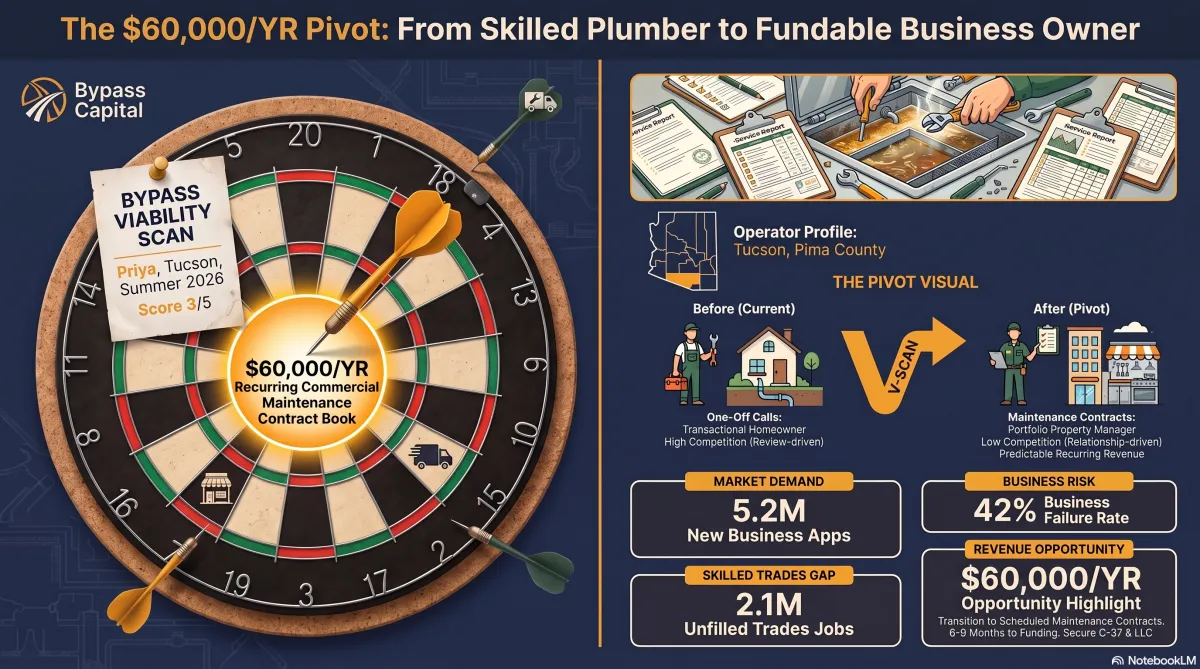
Priya's Story — Viable, But Business-Gated
A $5000 Budget and 5 Years of Skill Unlocked a $60000/YR Commercial Gap in Tucson, AZ.
⚠️ About This Case Study
These case studies are composite illustrations. The individuals featured are fictional and do not represent a real client. However, the market data, local opportunity, competitive landscape, pricing, and regulatory details referenced are based on real research for this trade and location. Results shown are illustrative of what the data suggests is possible — not a guarantee, promise, or projection of income. Your outcome depends on your effort, skill, capital, timing, and market conditions. Bypass Capital does not provide financial, legal, or tax advice. Always do your own due diligence and consult a qualified professional before starting or investing in any business.
Take a listen to the Deep Dive Podcast - Pivoting From Residential to Commercial Plumbing
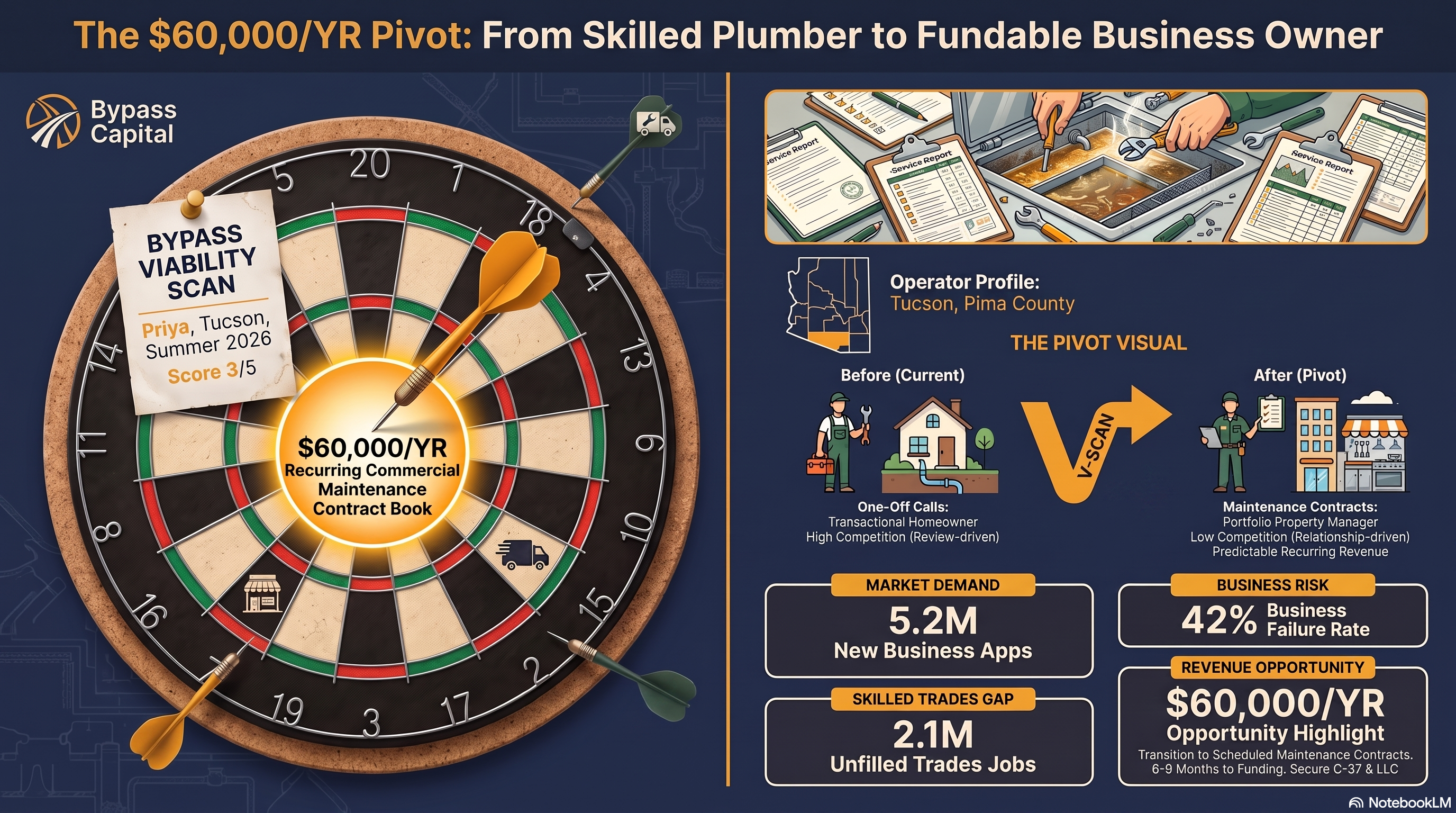
This is what Priya's V-Scan looked like — see what yours could show
Why the "Biggest" Plumbers in Tucson are Leaving a $60,000 Gap (And How to Fill It)
In the Tucson plumbing market, the landscape is dominated by a handful of high-volume titans. For a journeyman looking to strike out independently, the "V-Scan" intelligence is initially bruising: Cummings (3,833 reviews), Cal’s Plumbing (2,640 reviews), and Al Coronado (2,588 reviews) have effectively locked down the residential SEO map. Attempting to compete head-to-head for the standard "leaky faucet" call isn't just difficult; it’s a strategic error. However, "Case Study 15: Priya" identifies a critical V-Scan score of 3/5 🟡 Viable, But Business-Gated . This score reveals that while the market is crowded, it is structurally "Bypass-Ready." The giants are so bloated with overhead that they have left a high-margin, $60,000-per-year gap in commercial maintenance. By executing a "Bypass Pivot," an operator can stop fighting for scraps and start targeting the recurring revenue the big shops are too heavy to catch.
Takeaway 1: Stop Chasing the "One-Off" Ghost
Underbidding is a terminal business disease; the specialist path is the cure. Most new operators default to the Commodity Path , chasing one-off commercial service calls that result in tickets in the low hundreds. Because these jobs are transactional and unsystematized, you are forced to compete against multi-crew shops with decades of brand equity. The giants ignore small-scale maintenance contracts because a $1,500 annual agreement is an administrative nuisance for a shop with 50 trucks. For a solo operator, however, that same contract is a Portfolio Power Multiplier . This is the "Specialist Path": shifting from emergency repairs to predictable, scheduled maintenance."The core plumbing skill is identical; what changes is who you point it at."
Takeaway 2: Geography is Destiny (Hard Water and Monsoons)
In Tucson, the environment acts as your primary sales agent. The Arizona plumbing industry grew at an average annual rate of 5.3% from 2021 to 2026, and the demand is structural, not elective. Tucson’s extreme hard water buildup and intense monsoon drainage requirements create non-negotiable service needs. For a business, these aren't "if" problems; they are "when" problems.
●The Restaurant Corridor: Grease traps and drain systems run hard and must be serviced to stay within health code regulations .
●Institutional Bases (UA/Healthcare):These dense footprints buy maintenance contracts specifically to ensure zero downtime .When a hospital or a high-volume kitchen has a plumbing failure, the cost of the repair is secondary to the cost of the doors being closed. You are selling operational insurance, not just plumbing.
Takeaway 3: The "One Signature" Portfolio Strategy
To scale without an advertising budget, you must target "Anchor Clients." This strategy utilizes the One Signature concept: a single relationship with a property manager can yield a contract that covers an entire metro-wide portfolio. Strategic Geographic Targets in Tucson:
●The Restaurant & Hospitality Corridor: High-wear infrastructure requiring recurring drain flushing.
●University of Arizona / Healthcare / Retail: Institutional clients who value the predictability of a contract over the chaos of emergency bidding.
●Property-Manager Portfolios: The ultimate leverage point where one referral secures multiple properties with zero additional acquisition cost.
Takeaway 4: The Execution Roadmap (The Bootstrap Sequence)
Success in a "Business-Gated" market depends on systems, not just a pipe wrench. To reach a fundable state within 6–9 months, the following sequence is mandatory:
●Weeks 1–2: Estimating & Job-Costing Templates. This is the direct fix for the "underbidding" trap. You must know your margins before you turn a valve.
●Weeks 2–3: LLC Formation & Real Bookkeeping. Documented, systematized revenue is the only thing that makes a business "fundable."
●Months 1–2: Target Property Managers & Restaurant Groups. Shift your outreach from "I fix leaks" to "I manage your facility's uptime."
●Months 2–4: Systematize Scheduling. Ensure contracts renew on autopilot, turning your client list into a forecastable asset.
Takeaway 5: The "Working Capital Engine" Financial Hack
You do not need a bank loan to start; you need a deposit model. A journeyman with a$5,000–$ 25,000 budget can launch using this 5-step engine:
Win the Contract: Target multi-unit portfolios.
50% Deposit: Secure half the contract value upfront.
Purchase Materials: Use the client’s deposit to fund equipment and supplies—zero personal capital at risk.
Deliver Service: Execute the maintenance.
Final 50%:Collect the balance. Banks will not loan on the hope of getting a job. They will loan on ten signed maintenance contracts that represent $15,000 in recurring revenue. This model builds the track record that makes you an institutional borrower in under a year.
Takeaway 6: Compliance as a Competitive Shield
In Arizona, the Registrar of Contractors (ROC) license is often viewed as a bureaucratic hurdle. Reframe it: The paperwork is not bureaucracy; it is your protection. Without an Arizona ROC plumbing license, you have no legal standing to enforce a contract or collect payment on disputed work. For a commercial specialist, the license is the only thing that ensures you get paid when a large client's accounting department gets difficult. Consultant’s Note / Due Diligence: You must confirm the exact dollar threshold for when an ROC license is legally triggered in Arizona before executing large-scale commercial contracts.
The Bottom Line: The $60,000 Math
The "Specialist Path" is mathematically superior to the "Commodity Path." To hit a $60,000 revenue target, you have two choices:| Feature | The Commodity Path | The Specialist Path || ------ | ------ | ------ || Primary Job Type | One-off emergency calls | Commercial Maintenance Contracts || Average Ticket | Low hundreds (~$250) | $1,500 per property / year || Volume for $60k | 240+ jobs(The "Treadmill") | ~40 property contracts || Revenue Style | Transactional & Unpredictable | Predictable & Recurring |
North Star Positioning Statement: "Tucson Commercial Plumbing on Contract — Scheduled Maintenance That Keeps Your Doors Open and Your Health Inspector Happy."
Conclusion: What’s the Bullseye in Your Market?
Priya’s 6–9 month timeline to a fully fundable business is not a matter of luck; it is a matter of diagnostic precision. The "Biggest" players in Tucson have a massive blind spot: they are too large to care about the small-to-mid-sized commercial maintenance gaps that represent a life-changing income for a dedicated specialist. The intelligence is clear: stop fighting Goliath for the residential scraps. The real opportunity is in the contracts the giants feel are "too small" to manage. What is the hidden gap in your local market that the incumbents are too big to see?
BYPASS CAPITAL VIABILITY SCAN
Priya | Plumbing | Tucson, Arizona | Summer 2026
🎯 THE BYPASS VIABILITY GAUGE — SCORE: 3/5 🟡 VIABLE, BUSINESS-GATED
Territory Tier: Tier 2 — Mid-Size Market (Tucson metro area, pop. ~1.05M; Pima County pop. ~1.09M) · Expanded county-level research applied
🚨 PIVOT RECOMMENDED: Your current path is high-friction. See the Bypass Pivot section below to find the high-margin gap in your market.
Section 1 — THE VERDICT
Priya, you scored a 3 — Viable, Business-Gated — and the gap here isn't your hands, it's your paperwork. Five-plus years as a journeyman plumber in Tucson means the trade skill is not in question. What's capping you is the same thing that caps most solo operators: no systematized way to sell, price, and deliver work at scale. Tucson is a real, stable mid-size market — not a boomtown with a hyperscale corridor to ride, but not a ghost town either — and it already has several well-run, high-review-count plumbing operators who've been at this for decades. You can absolutely build a survivable business bidding against them call for call. But you'll hit a ceiling doing that, and the ceiling isn't market size — it's you competing as a generalist against generalists on their turf instead of building a lane where business systems, not wrench skill, decide who wins.
That's what a 3 means for you specifically: the market has room, your skill clears the bar, and the pivot below is not a rescue plan — it's the upgrade that turns your experience into a business instead of a paycheck with more steps.
Section 2 — THE LOCAL REALITY CHECK
The Competitive Landscape
Tucson's residential plumbing field is dominated by a handful of long-established, review-heavy operators: Cummings Plumbing (over 2,900 five-star reviews, the market's clear volume leader), Jobe & Sons Plumbing (505 Google reviews averaging 5.0 stars), Code Blue Plumbing, Sampson's Plumbing and Water Treatment (25 years in business), Waterway Plumbing, and Plumber of Tucson (20+ years, 24/7 emergency positioning). These are not weak or thin operators — they're competent, well-marketed businesses that have owned the residential emergency-call space for years.
The Demand Signal
Tucson metro carries roughly 1.05 million people and Pima County sits at about 1.09 million (2nd most populous county in Arizona) — a real, durable mid-size market, not a fringe territory (World Population Review; Pima County). But unlike Phoenix to the north, which has a massive semiconductor and data-center investment wave driving construction demand, Tucson has no comparable hyperscale corridor pulling in outsized commercial building activity. This is a market you grow into methodically through relationships, not one where a single mega-project tailwind carries you.
The Big Guy Weakness
Every named competitor above is built and marketed around the same model: reactive residential service calls, won on reviews and response speed. None of them are positioned as the go-to scheduled-maintenance vendor for property managers and light commercial accounts — the recurring, contract-based relationship that doesn't require re-winning the customer every single time. That's the door standing open: not a skill gap, a business-model gap.
Local Factors
Arizona's C-37 Specialty Commercial Plumbing license requires a minimum of four years of documented experience working under a licensed plumber — your 5+ years clears that bar with room to spare — plus passing the trade exam and the state's Statutes and Rules exam, and posting a surety bond sized to your projected annual volume (Arizona Registrar of Contractors). Tucson's desert climate also matters for the commercial pitch: hard water and mineral scale place real wear on commercial water heaters, boilers, and fixtures, and the summer monsoon season (July–September) adds drainage and backflow stress that gives property managers a concrete, recurring reason to want scheduled inspections instead of waiting for a failure.
Section 3 — THE BYPASS PIVOT — The 80/20 Move
Priya, your pivot isn't a new trade — it's a new business model layered on the one you already have: scheduled commercial maintenance contracts for property managers and light commercial accounts, instead of one-off residential service calls. Same wrench, same license track, radically different revenue math and radically less price competition.
Positioning statement (truck-wrap ready): "Scheduled Commercial Plumbing Maintenance — Predictable Costs, Zero Surprise Repairs, for Tucson Property Managers."
Ticket math: A typical Tucson residential repair call runs $277 to $399 — a one-time job you have to re-win from a fresh customer every time, competing on price against Cummings and Jobe & Sons on Yelp reviews (Homeyou). A scheduled commercial preventive-maintenance contract on a medium-size property runs $2,400 to $4,800 a year, billed on a predictable flat schedule — and it's an easy sell to a property manager once you can show it protects them from a $5,000 to $25,000 emergency burst-pipe loss caused by neglect (BuildOps; Norse Mechanical). One signed maintenance contract is worth roughly six to twelve emergency calls, without the marketing spend to win each one.
Fastest path → scale play: (1) Build the business infrastructure first — a written maintenance-agreement template, a clear pricing sheet, and a simple scheduling system, since your named hurdle is business execution, not plumbing competence; (2) target Tucson's commercial property managers directly — Cushman & Wakefield | PICOR alone manages over 4.7 million square feet regionally, and firms like Larsen Baker and Tucson Realty & Trust round out a realistic first-outreach list; (3) once you have two or three signed maintenance accounts as proof, use that documented recurring revenue to negotiate larger portfolio-level contracts. Since your Primary Goal is a full-time plumbing business, this recurring base is what makes the business fundable and eventually sellable — not just busy.
Section 4 — FUNDING READINESS
Priya, picture the fight you're actually in. You step into the ring against Cummings Plumbing's 2,900 five-star reviews, Jobe & Sons' decade-plus reputation, Code Blue and Sampson's both fighting for the same residential calls, Tucson's monsoon season putting real wear on the equipment you'll be maintaining, the Arizona Registrar of Contractors' C-37 exam standing between you and a commercial license, and a banker who's going to ask for financials and systems you haven't built yet. That's a full corner, and none of it is about whether you can turn a wrench.
Every fighter who ever won under those lights had one thing in common: a corner man. Somebody who didn't throw the punches for her, but knew the fight, patched her up between rounds, and told her the truth about when to swing and when to wait. That's what Bypass Capital is — your corner man. And a good corner man never pushes a fighter into the ring before she's ready. Neither do we.
Let's name your hurdle directly, Priya: it's the Business Side, not capital, and not skill. You have the trade experience and a real budget in place — what you don't have yet is the entity, the pricing structure, and the documented delivery system that turns "skilled plumber" into "fundable business owner" in a lender's eyes.
Funding Readiness Assessment: At 5+ years experience with a $5k–$25k budget, you sit in the entity-formation-and-documentation band. The trade skill is proven; what's missing is the paper trail — a formed LLC, a written maintenance-contract template, and even one or two signed commercial accounts to point to as evidence you can deliver, not just repair.
The Single Most Important Action: Form your LLC and get your Arizona C-37 Commercial Plumbing Contractor license application moving through the Registrar of Contractors this month. Everything else — pricing sheets, property manager pitches, funding conversations — sits downstream of having the legal entity and license in place.
Realistic Timeline: ~4–8 months to a fundable position — LLC and C-37 license secured, a written maintenance-agreement template built, and at least one or two signed commercial accounts generating documented recurring revenue.
And here's why the corner man matters when the bell rings, Priya. Bypass Capital works differently than a traditional lender: approval rates are higher, the process moves in days not months, the paperwork won't bury you, and there are funding options built for startup operators a bank can't match. When your foundation is in place, we're the corner that gets you moving faster than any bank would allow.
When you're ready to step into your corner, it starts with a standard application — it tells us where you stand and what you need, so the conversation opens with real answers, not guesswork. Apply here: [APPLICATION LINK]
Section 5 — THE NEXT MOVE
This is not a summary. This is a starting gun.
The One Action (next 7 days): File your Arizona LLC and submit your C-37 Commercial Plumbing Contractor license application through the Registrar of Contractors — you already meet the four-year experience minimum, so this is a paperwork clock you can start today. Nothing downstream — contracts, pitches, funding — can start until this entity and license are in motion.
The 30 Day Marker: Thirty days from now you should have your LLC formed, your C-37 application submitted, a written maintenance-agreement template and pricing sheet built, and a target list of at least five Tucson property managers — PICOR, Larsen Baker, and Tucson Realty & Trust among them — with named contacts identified for outreach.
The Honest Warning: Priya, if you skip building the business systems and keep taking one-off residential calls, you'll spend the next five years exactly where you are now — a skilled plumber competing on price against Cummings and Jobe & Sons, with no ceiling in sight. The business side isn't optional here; it's the entire pivot.
Sources: World Population Review, Tucson AZ 2026 population data; Pima County, AZ demographics; Yelp, DownToBid, and ServiceAgent commercial plumbing directories (Cummings Plumbing, Jobe & Sons Plumbing, Code Blue Plumbing, Sampson's Plumbing, Waterway Plumbing, Plumber of Tucson); Arizona Registrar of Contractors C-37 license classification; Homeyou Tucson plumbing repair cost data; BuildOps and Norse Mechanical commercial plumbing maintenance contract pricing guides; PICOR (Cushman & Wakefield), Larsen Baker, and Tucson Realty & Trust commercial property management listings.
Walk through Priya's complete market breakdown slide by slide — the Tucson competitors, the ticket math, and the exact paperwork that turns a skilled plumber into a fundable business owner.
Click here to see the The Tucson Commercial Plumbing Pivot Slide Deck.
What's the Bullseye in your market? Take the free V-Scan → bypasscapital.com/vscan.
Here are several additional Plumbing Posts
→Marcus found a $45,000/year gap hiding in Cleveland's shrinking plumbing market — see how →
→A $1,000 budget, a soft market, and an honest 2/5 score — see Dale's bootstrap path anyway →