Why Your Remodeling Business is Losing the Price War—and the _Pivot_ That Saves It
The $110k Pivot:
Escaping the Remodeling Price War
⚠️ About This Case Study
These case studies are composite illustrations. The individuals featured are fictional and do not represent a real client. However, the market data, local opportunity, competitive landscape, pricing, and regulatory details referenced are based on real research for this trade and location. Results shown are illustrative of what the data suggests is possible — not a guarantee, promise, or projection of income. Your outcome depends on your effort, skill, capital, timing, and market conditions. Bypass Capital does not provide financial, legal, or tax advice. Always do your own due diligence and consult a qualified professional before starting or investing in any business.
Take a listen to the Deep Dive Podcast - Specialized trades beat market saturation
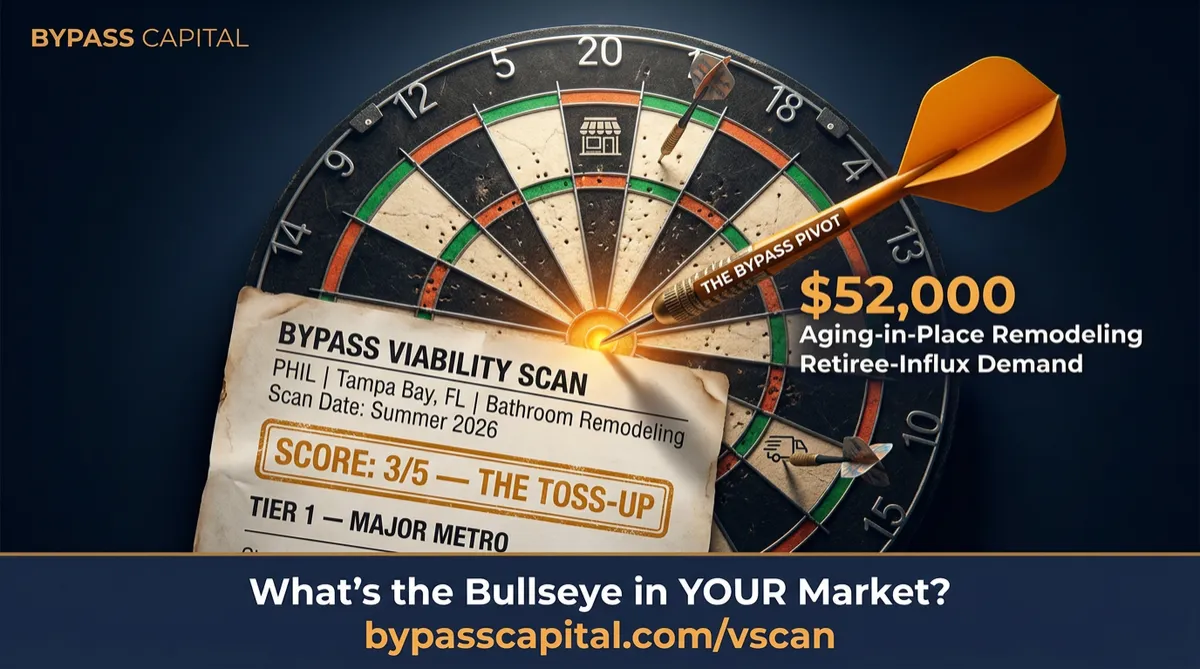
Below you can see what Phil's V-Scan looks like — see what yours could show
Why Your Remodeling Business is Losing the Price War—and the "Pivot" That Saves It
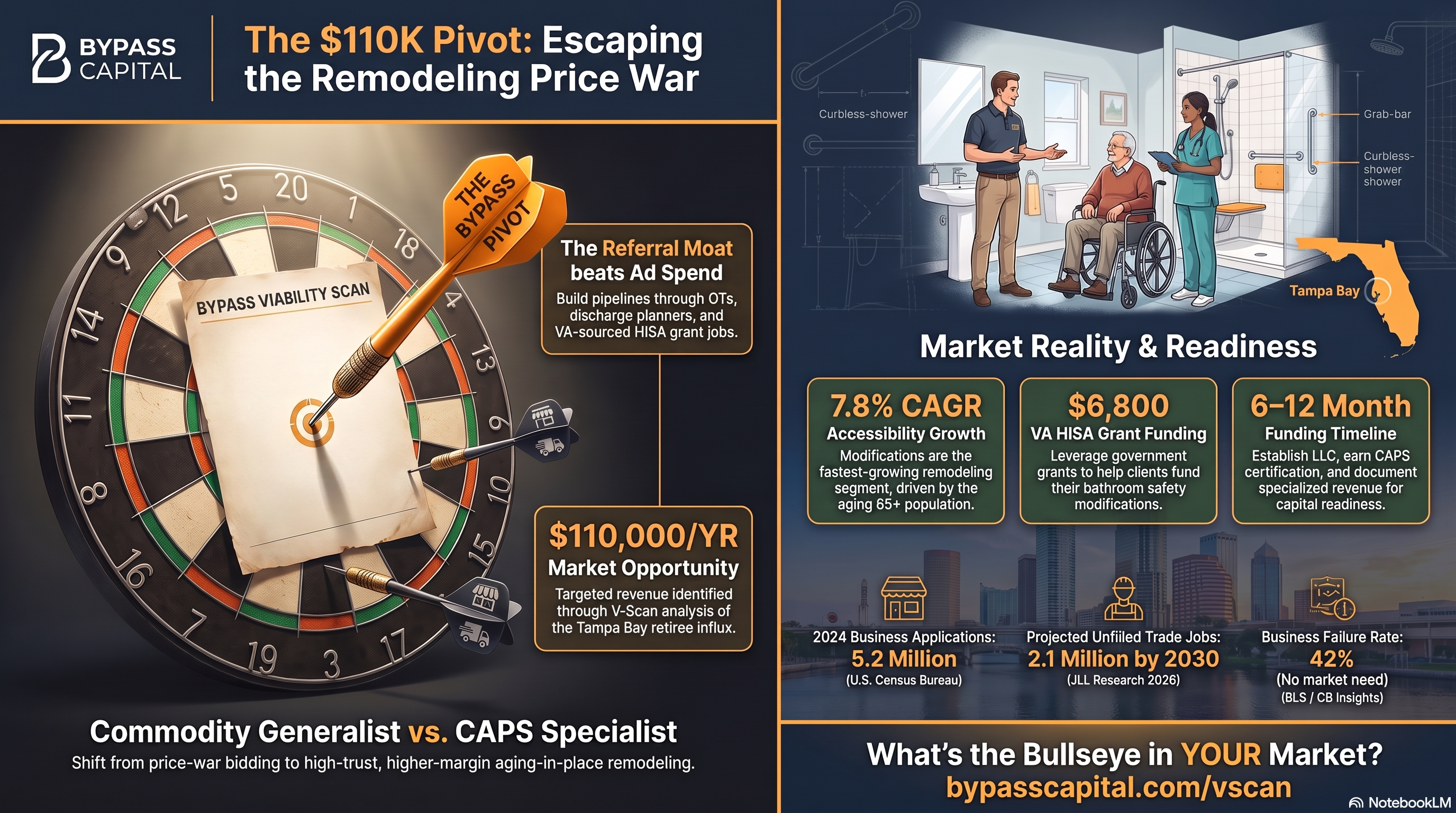
The Remodeler’s "Cage Match" Operating as a general bathroom remodeler in Tampa is no longer just a business—it is a cage match. Every morning you step into the ring against national franchises and entrenched local heavyweights like S&W Kitchens, which boasts 48 years of history and seven showrooms. You are fighting for oxygen against outfits like New Bay Remodeling and Everlast that have the ad budgets to dominate homeowner attention before you even pick up the phone. If you continue to compete as "remodeler #200," you are already losing. In a market saturated with "one-day-bath" specialists and licensed/insured incumbents, your survival depends on the "Bypass Pivot." To escape the price war, you must stop being a generic contractor and become a specialized solution that the big players are too bulky to replicate. The 80/20 Truth: Why Generalists Drown While Specialists Scale Most remodelers remain trapped in the "80%" commodity pool because they fear narrowing their market. This is the Commodity Path, where you bid on general work, compete strictly on price, and watch your margins bleed out to competitors with larger economies of scale. The Specialist Path is a protected moat. By transitioning from general aesthetics to high-stakes modifications, you move into a sector where competition is thin and margins are preserved. This transition typically requires a budget of$5K–$ 25K for certification and targeted marketing—a small price to pay to stop fighting a war you cannot win on volume. "Tampa Bay's certified aging-in-place bathroom specialist — referred by the OTs and communities who know safety matters." The Safety Driver: The Bathroom as the #1 Priority The market is reclassifying the bathroom as essential health infrastructure. This isn't about luxury tile; it’s about life and death. With 70%+ of senior falls occurring in the bathroom, this room has become the primary modification priority for the aging population (Everlast, 2026).When a project is a health necessity, the client’s psychology shifts. They are no longer looking for the lowest bidder to install a vanity. They are looking for a specialist who can ensure their independence. By positioning yourself here, you transition from a "want" to a "must-have" service. The Invisible Growth Wave: By the Numbers This shift is not a temporary trend, but a demographic certainty providing a massive national tailwind for specialized businesses. The data confirms the scale of the opportunity:
●7.8% CAGR: The projected growth rate for accessibility modifications, the fastest-growing segment in bathroom remodeling (Emergen Research, 2026).
●73% Demand: The percentage of remodelers already reporting a rise in demand for aging-in-place work (NAHB, 2026).
●3x Population Growth: The 85+ population is expected to triple by 2040.
●56% Market Adoption: While over half of remodelers are already attempting this work, few have the certification required to own the "trust" category (NAHB, 2026).Building a "Referral Moat" Instead of an Ad Budget The "Big Guy Weakness" of national franchises is their reliance on high-volume, generic advertising. They treat accessibility as a product line—like a walk-in tub—rather than a specialized service. You beat them by building a "referral moat" that they cannot buy with an ad budget. Your goal is to cultivate high-trust pipelines with professionals who direct retirees to exactly who they should hire. This includes Occupational Therapists (OTs), hospital discharge planners, and senior living communities. Furthermore, tapping into VA channels allows you to utilize the HISA grant, which provides up to ~$6,800 for modifications. This mechanism ensures you are paid for specialized work while the veteran receives essential safety upgrades without out-of-pocket strain. "The decisive factor in a saturated metro: trust and referral, not ad spend — which is exactly where a CAPS specialist with a medical-referral network beats a bigger, generic competitor." The "Corner Man" Strategy: Preparing for Capital In this fight, you need a partner who knows the ring. Bypass Capital is your "Corner Man"—the entity that patches you up between rounds and provides the capital to scale once your foundation is set. We don’t push fighters into the ring before they are ready; we provide the funding options traditional banks won't touch once your "specialized revenue" is proven. Moving from a "Toss-Up" to a fundable position requires documenting your pivot. Lenders value specialized revenue over generic volume. To get scale-ready, you must form an LLC, earn your Certified Aging-in-Place Specialist (CAPS) credential, and run your first referral-sourced jobs through a dedicated business account. This creates the specialized revenue trail required to unlock growth capital. Expect a 6–12 month timeline to reach a fully fundable position where Bypass Capital can fund your crew and working capital scale-up faster than any bank. Conclusion: The Final Thought-Provoking Question The hurdle between you and a scalable business is not your technical skill or the availability of capital. It is the courage to specialize. The Tampa market is already being divided between commodity contractors and high-value specialists. As you look at your operations today, you must answer one question: Are you building one more "commodity truck" destined to fight for the lowest bid, or are you building a scarce specialty that the market is now demanding as essential infrastructure?
🛁 Bypass Viability Report — Phil · Bathroom Remodeling · Tampa, FL
🟡 THE BYPASS VIABILITY GAUGE: 3 / 5 — "The Toss-Up"
📍 Territory Tier: Tier 1 — Major Metro (Tampa Bay, FL — high retiree-influx metro)
🚨 PIVOT RECOMMENDED: Big demand, crowded field. Your moat is CAPS + referral pipelines. See The Bypass Pivot.
Section 1 — THE VERDICT
Phil, this is a 3 — a classic Toss-Up where demand is strong and competition is thick. Tampa Bay is a major retiree-influx metro riding the same national wave: 56% of remodelers now do aging-in-place work and 73% report rising demand (NAHB, 2026), with accessibility modifications the fastest-growing remodeling category at ~7.8% CAGR (Emergen Research, 2026). But the flip side: Tampa is saturated with bath remodelers and one-day-bath outfits — New Bay Remodeling, Everlast, S&W Kitchens (with CAPS designers), and national franchises all fighting for the same homeowner (New Bay, 2026; S&W, 2026). You've got 5+ years — enough to escape the pack, but only if you specialize up into certified aging-in-place with a referral moat. That's the 3, and the pivot is the whole game.
Section 2 — THE LOCAL REALITY CHECK
The Competitive Landscape. Deep and professionalized. The top tier already markets CAPS certification and 5-year warranties (S&W's 48 years and 7 showrooms; New Bay's licensed/insured positioning). Commodity bath remodelers are everywhere. Compete on "I remodel bathrooms" and you're bidding on price against franchises with ad budgets. The escape is a narrower, deeper specialization plus referral relationships they don't cultivate.
The Demand Signal. (1) A large, growing retiree-influx metro feeding constant aging-in-place demand (regional/national, NAHB). (2) The safety driver — 70%+ of senior falls happen in the bathroom, making the room the #1 modification priority (local, Everlast, 2026). (3) A national tailwind — accessibility modifications growing 7.8% CAGR, the fastest segment in bath remodeling, driven by the 85+ population tripling by 2040 (national, Emergen Research).
The Big Guy Weakness. The volume shops and franchises chase broad bath work and treat accessibility as a product line (walk-in tubs, grab bars). The gap your 5+ years fills is true CAPS-level specialization plus a medical/senior referral pipeline — OTs, discharge planners, senior communities, and VA-grant-eligible veterans (the VA covers up to ~$6,800 HISA for modifications). Franchises advertise; they don't build referral trust with the people who tell retirees who to hire.
Local Factors. Florida licensing and humid-climate build standards reward a credentialed operator. The decisive factor in a saturated metro: trust and referral, not ad spend — which is exactly where a CAPS specialist with a medical-referral network beats a bigger, generic competitor.
Section 3 — THE BYPASS PIVOT — The 80/20 Move
Phil, your Competition hurdle breaks the moment you stop being "Tampa bath remodeler #200" and become the certified aging-in-place specialist with a medical-referral pipeline. Your 5+ years is the foundation; CAPS plus referral relationships is the ticket the commodity crowd can't punch.
Positioning statement: "Tampa Bay's certified aging-in-place bathroom specialist — referred by the OTs and communities who know safety matters."
The specialization math:
Commodity path: bid general bath remodels against franchises with ad budgets, win on price, bleed margin.
Specialist path: get CAPS certified, then build referral pipelines with occupational therapists, hospital discharge planners, senior living communities, and VA channels — higher-trust, higher-margin work where you're one of few credible specialists instead of one of hundreds. Your $5K–$25K covers certification and marketing to referral sources, not a price war.
Fastest path to first revenue → scale: Your goal is a full-time aging-in-place business and your hurdle is competition, so lead with CAPS + referrals to the people who route senior clients. Land referred work first, build a reputation among referral sources, then scale as the 85+ wave accelerates.
The 80/20 truth: The crowd fights over the 80% of commodity bath work through ads. The 20% — certified, referred aging-in-place work — is where the margin and the moat live, and where your certification makes you a scarce specialist instead of one more truck.
Section 4 — FUNDING READINESS
Phil, picture how your morning really starts. You lace up your boots and step into a cage match — and in Tampa the ring is packed with franchises and one-day-bath outfits before you've thrown a punch. In the other corners: national brands with ad budgets and 5-year warranties, retiree clients who need to trust you first, Florida licensing and humid-climate standards, a referral network you haven't fully tapped, and a banker weighing a $5K–$25K budget against a metro full of established competitors. Six opponents deep, every day. That's the job.
Every fighter who ever won under those lights had one thing in common: a corner man. Somebody who didn't throw the punches for him, but knew the fight, patched him up between rounds, and told him the truth about when to swing and when to wait. That's what Bypass Capital is — your corner man. And a good corner man never pushes a fighter into the ring before he's ready. Neither do we.
Your hurdle is Competition, not capital — but let's be honest about your position. At 5+ years, still employed, with a $5K–$25K budget, you're in the certify-and-document band. The skill is there; what a lender needs to see is the LLC, the CAPS credential in your own name, and documented specialized revenue that proves you win the referred aging-in-place work, not the commodity work.
The Single Most Important Action: Form your LLC and earn your CAPS certification now, then run your first referral-sourced aging-in-place job through a dedicated business account — documented specialized revenue is what separates you from the hundreds of generic remodelers in a lender's eyes.
Realistic Timeline: ~6–12 months to a fundable position — entity and CAPS squared, clean business banking, and a documented stack of referred aging-in-place work.
And here's why the corner man matters when the bell rings, Phil. Bypass Capital works differently than a traditional lender: approval rates are higher, the process moves in days not months, the paperwork won't bury you, and there are funding options built for startup operators a bank can't match. Once your entity and specialized revenue trail are in place, we're the corner that funds your crew and working-capital scale-up faster than any bank would allow.
Next step: When you're ready to step into your corner, it starts with a standard application — it tells us where you stand and what you need, so the conversation opens with real answers, not guesswork. Apply here: [APPLICATION LINK]
Section 5 — THE NEXT MOVE
The One Action (next 7 days): Enroll in CAPS and identify three referral sources — an OT practice, a senior living community, and a VA/discharge contact — to build your pipeline around. That's your escape from the ad-spend war.
The 30-Day Marker: 30 days out you should have your LLC formed, CAPS in progress, and at least one referral relationship or specialized bid in motion.
The Honest Warning: Phil, if you launch as one more general bath remodeler in a franchise-saturated metro, you'll drown on price — the only version that works is the certified, referral-driven specialist version, so plant that flag from day one.
Some other Case Studies that may interest you.
→A $31,000 remodel vs. $112,000 a year in nursing care — see the math behind Gloria's niche →
→How an Atlanta HVAC tech built a bridge off payroll without quitting her day job first →