The Atlanta HVAC Paradox_ Why 20,000 Reviews Don’t Mean You’ve Lost the Market
The Exact Data That Revealed $55,000/YR In Commercial PM Contracts and IAQ Across Atlanta.
⚠️ About This Case Study
These case studies are composite illustrations. The individuals featured are fictional and do not represent a real client. However, the market data, local opportunity, competitive landscape, pricing, and regulatory details referenced are based on real research for this trade and location. Results shown are illustrative of what the data suggests is possible — not a guarantee, promise, or projection of income. Your outcome depends on your effort, skill, capital, timing, and market conditions. Bypass Capital does not provide financial, legal, or tax advice. Always do your own due diligence and consult a qualified professional before starting or investing in any business.
The Deep Dive Podcast- Beating the Atlanta HVAC Review Goliath
The Atlanta HVAC Paradox: Why 20,000 Reviews Don’t Mean You’ve Lost the Market
In the Atlanta metropolitan area, the HVAC industry presents a striking contradiction. With a population of approximately 6.3 million and near-universal (99%) air conditioning penetration, demand is not speculative—it is structural. In a climate where summer dew points routinely exceed 70°F, climate control is a fundamental survival utility. However, a cold-eyed analysis of the local trade landscape reveals a viability score of3 out of 5—"The Toss-Up ."This rating is not a reflection of a weak market; it is a warning of a "cage match" environment where high-friction saturation meets massive, entrenched incumbents. For an emerging operator, success is no longer a matter of technical skill alone, but of strategic positioning in the gaps these giants have left behind.
Scaling the "Review Wall" is a Losing Battle
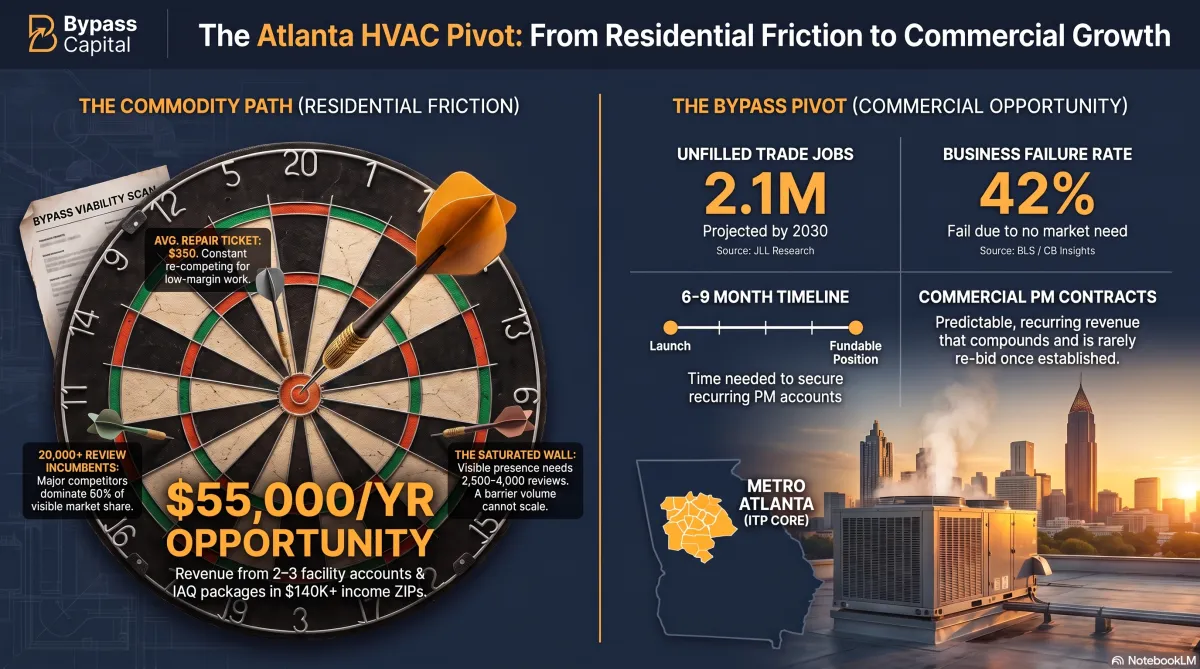
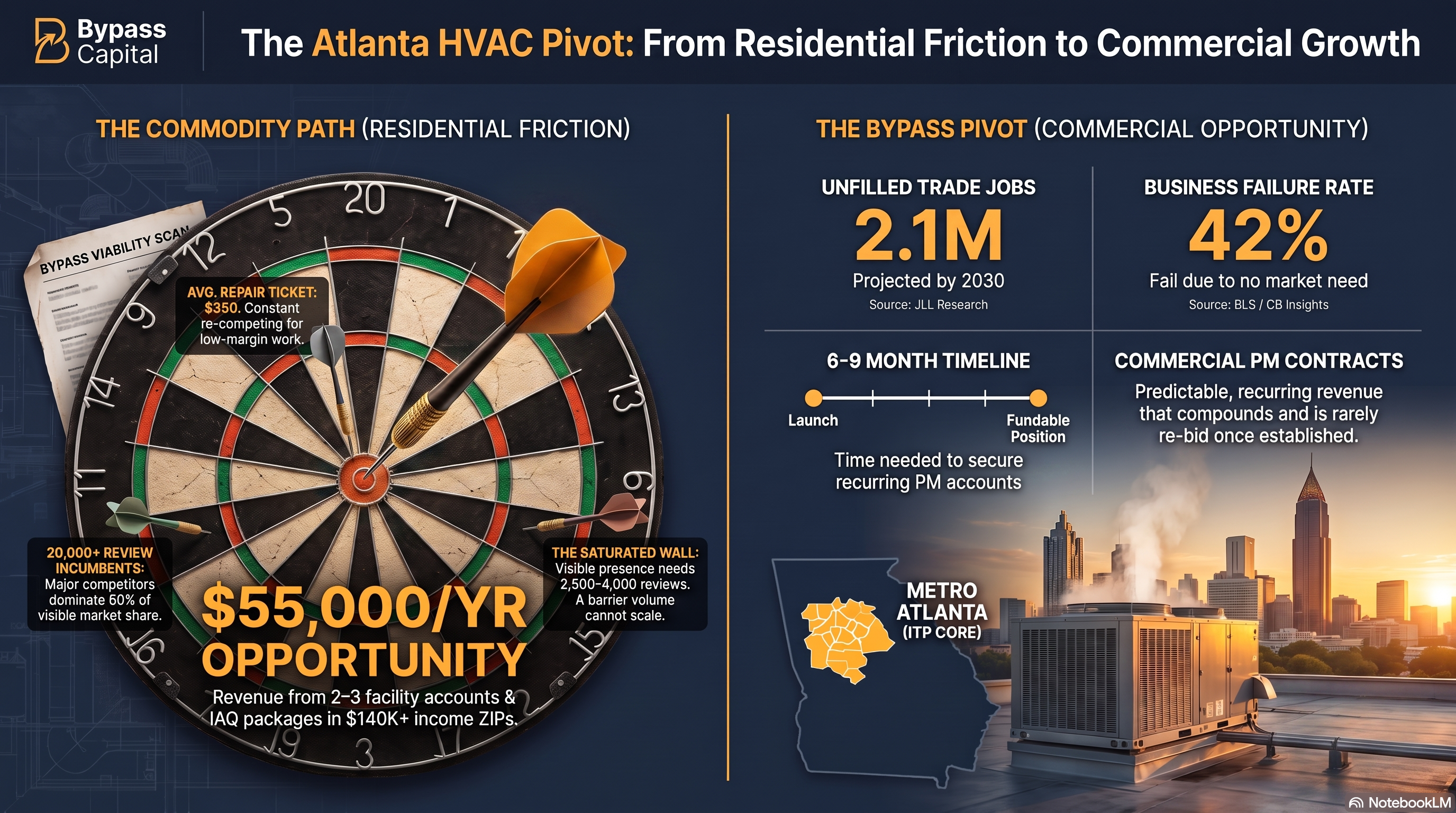
The Atlanta HVAC landscape is currently dominated by a handful of massive incumbents who have constructed a "visibility wall." Market leaders like Coolray (22,400 Google reviews) and Reliable Heating & Air (19,700 reviews) have achieved a scale that effectively locks up the top of the funnel. When you include other major players like Casteel, Estes, and Moncrief, these top-tier incumbents control roughly60% of the visible market share .For a new entrant, the math is brutal: to even appear consistently in the "map-pack" for broad queries like "AC repair Atlanta," an operator generally needs a threshold of 2,500 to 4,000 reviews. Attempting to compete as a residential generalist is a high-friction, low-yield strategy because even local proximity weighting cannot overcome the sheer volume of social proof held by the giants. "The 3 isn't a demand problem... it's a positioning problem."
The "80/20" Pivot: Solving the Time Hurdle via Commercial Uptime
For an operator like Denise—who possesses 3–5 years of experience but remains tied to a W-2 employment "Time" hurdle—the residential "break-fix" model is a trap. Chasing one-off $350 repairs requires constant ad spend and immediate availability, which is impossible while holding a day job. The "80/20" move is to pivot toward Commercial Preventive-Maintenance (PM) contracts .
●The Commodity Path: Re-competing for every residential lead in a saturated market.
●The PM Path: Securing recurring maintenance agreements for portfolios—medical offices, retail centers, churches, and daycares. These clients represent the 20% of the market that the "Big Guys" under-prioritize in favor of high-volume residential swap-outs. Commercial PMs provide the "bridge income" necessary to quit a day job. They are relationship-driven sales that can be cultivated on nights and weekends, creating a compounding revenue stream that doesn't get re-bid at every service call.
Humidity as a High-Margin Product, Not Just a Nuisance
Atlanta’s persistent humidity offers a significant opportunity to treat Indoor Air Quality (IAQ) as a dedicated product line rather than a website line item. Furthermore, current regulatory catalysts are opening a massive "replacement window. "The transition from R-410A to R-454B refrigerants and the availability of the federal 25C tax credit ($2,000) provide immediate levers to push for system replacements. By positioning as a specialist in whole-home dehumidification, MERV-13 filtration, and UV lighting, an operator can capture margins materially higher than standard repairs. These installations also secure secondary revenue through recurring filter and bulb replacements over the equipment’s lifespan.
Geography and the Licensure Moat
In Atlanta, geography is destiny. The congestion of I-285 dictates that owning a specific sub-market is superior to chasing leads across the entire metro. Strategic operators should target "replacement-window" ZIP codes where 25-to-45-year-old equipment meets high median incomes. High-Value Target ZIP Codes:
●Buckhead (30327):Median income$140K–$ 174K; high density of aging systems.
●Alpharetta (30005):Prime territory for $10K+ full-system replacement tickets.
●Roswell (30075):Strong demand for IAQ and high-efficiency upgrades.
●Johns Creek (30022):High-income demographic favoring premium PM contracts.
●East Cobb (30068):Established residential base with structural cooling needs. Crucially, the Georgia Conditioned Air Contractor license(Class I for systems up to 175,000 BTU; Class II for unrestricted) serves as a legitimate credential barrier. This regulatory moat prevents casual "handyman" competition from eroding the professional margins of licensed operators.
The "Corner Man" vs. The Banker
The transition from a technician to a business owner is a psychological and financial battle. Traditional banks often look at tradespeople with skepticism, demanding years of documentation that a startup simply doesn't have. "Picture how every trades operator's morning actually starts. You lace up your boots, and the second you step out the door you're walking into a cage match—and you're outnumbered. In the other corners: the competition with 20,000 reviews, the cranky customer... Mother Nature spiking a 95° heat wave... the supplier who just raised prices again, and the banker shaking his head at your file. "This is where the "Corner Man" philosophy of Bypass Capital differentiates itself. Unlike a traditional lender, a "corner man" moves in days, not months, with paperwork that won't bury the operator. For those in the "training rounds" (W-2 employed), the focus must be on entity formation and establishing a documented revenue trail . By forming an LLC and running even the first few commercial PM contracts through a dedicated business account, the operator builds the "ring-ready" proof of concept that Bypass Capital uses to provide funding that banks flat-out can't match.
Conclusion: The Seven-Day Challenge
The Atlanta HVAC market is not too crowded to enter; it is simply too crowded to enter without a specialist’s edge. The "3 out of 5" score is a mandate to stop competing on volume and start competing on relationships and recurring contracts. The One Action for the Next Seven Days: Identify and walk into three small commercial facilities in your home sub-market—a medical/dental office, a strip retail center, and a daycare. Ask who currently handles their HVAC maintenance. This is the first step in building a PM pipeline that serves as your exit ramp from your W-2.The cost of waiting for the "perfect time" is absolute. Every month of delay is another month an incumbent locks up a recurring contract that could have been your bridge to independence. When will you stop training and step into the ring?
Checkout Denise's V-Scan report below, then click here and see what yours might look like.
Denise's V-Scan Report
🌡️ Bypass Viability Report — Denise · HVAC · Atlanta, GA
🟡 THE BYPASS VIABILITY GAUGE: 3 / 5 — "The Toss-Up"
📍 Territory Tier: Tier 1 — Major Metro (Atlanta metro, pop. ~6.3M)
🚨 PIVOT RECOMMENDED: Your current path is high-friction. See The Bypass Pivot below for the high-margin gap.
Section 1 — THE VERDICT
Denise, straight up: a 3 is the honest read on residential HVAC in Atlanta, and your 3-to-5 years plus a full-time tech job is exactly why it's not lower. The demand in this metro is real — nearly every home in Georgia runs AC and summer dew points routinely sit above 70°F — but so is the crowd. This is one of the most review-saturated HVAC markets in the country, where Coolray (22,400 Google reviews) and Reliable (19,700) together hold roughly 60% of visible market share, with Casteel, Estes, Moncrief and a dozen more fighting for the rest (Built on Tenth, Apr 2026). If you walk in as another "AC repair Atlanta" generalist, you're bidding against 20,000-review incumbents for calls proximity weighting should have handed you. The 3 isn't a demand problem, Denise — it's a positioning problem, and your "Time" hurdle means you need to solve it while still on payroll.
Section 2 — THE LOCAL REALITY CHECK
The Competitive Landscape. Saturated at the top and crowded in the middle. Named metro leaders (Google Maps, Apr 2026, local): Coolray (22,400 reviews, 4.8★), Reliable Heating & Air (19,700, 4.8★), Casteel (11,200, 4.9★), Estes Services (~8,600, 4.9★), Moncrief (3,190, 4.8★), Shumate (4,300, 4.9★). Entry threshold for consistent map-pack presence on broad queries is ~2,500–4,000 reviews — a wall you will not scale on volume alone.
The Demand Signal. (1) Metro of 6.3M with ~99% AC penetration — demand is structural, not speculative (regional/state). (2) Replacement-window ZIPs where 25-to-45-year-old equipment meets $140K–$174K median incomes: Buckhead 30327, Alpharetta 30005, Roswell 30075, Johns Creek 30022, East Cobb 30068 — these are where $10K+ full-system tickets live (Census ACS, local ZIP). (3) Commercial construction nationally hitting ~$567B in 2026, which drives longer-term service contracts (Jobber, national).
The Big Guy Weakness. The incumbents chase broad metro visibility and high-volume residential swap-and-repair. Two gaps they leave open: (1) commercial preventive-maintenance contracts — recurring, unglamorous, relationship-driven work the fleet-advertisers under-prioritize; and (2) productized Indoor Air Quality — Atlanta's humidity makes whole-home dehumidification, MERV-13 filtration and UV a genuine health sell, yet even the leaders treat IAQ as a website line item rather than a dedicated product line with its own recurring filter/bulb revenue.
Local Factors. All legitimate operators need a Georgia Conditioned Air Contractor license (Class I up to 175,000 BTU; Class II above) — a real credential barrier that keeps casual competitors out. Metro traffic split by I-285 (ITP vs. OTP) rewards operators who own one sub-market instead of chasing the whole metro. The federal 25C credit ($2,000) and the R-410A→R-454B refrigerant transition both push replacement conversations in your favor.
Section 3 — THE BYPASS PIVOT — The 80/20 Move
Denise, your pivot is a two-lane play built on recurring revenue: commercial preventive-maintenance (PM) contracts, with Indoor Air Quality as the residential margin booster. You stop being the 4,001st name in "AC repair Atlanta" and become the operator property managers and small-facility owners keep on retainer.
Positioning statement for the truck/site: "Atlanta's uptime specialists — commercial HVAC maintenance contracts that keep your building running and your air clean."
The ticket math:
Commodity path: a one-off residential AC repair averages ~$350, and you're re-competing for the next call every time.
PM path: a commercial preventive-maintenance agreement bills recurring quarterly/semi-annual service across a portfolio — predictable revenue that compounds and doesn't get re-bid every service call. Add IAQ: a whole-home dehumidifier or MERV-13/UV package carries gross margins materially above a standard repair, plus recurring filter and UV-bulb revenue over the equipment's life.
Fastest path to first revenue → longer-term scale: Because your hurdle is Time and your goal is a full-time HVAC business, sequence it. Land 2–3 small commercial PM accounts (a strip retail center, a medical office, a church) on nights/weekends while employed — these are relationship sales, not ad-spend battles. That base becomes your bridge income to justify the leap, then scale the PM book and layer IAQ upsells into every residential call you take on the side.
The 80/20 truth: The Big Guys are too busy chasing the 80% of one-off residential volume to court the 20% of steady commercial contract clients who value a specialist who actually shows up.
Section 4 — FUNDING READINESS
Denise, picture how every trades operator's morning actually starts. You lace up your boots, and the second you step out the door you're walking into a cage match — and you're outnumbered. In the other corners: the competition with 20,000 reviews, the cranky customer who wants it done yesterday for half the price, Mother Nature spiking a 95° heat wave right when your van's in the shop, the supplier who just raised prices again, and the banker shaking his head at your file. Six opponents before your first coffee. That's the job.
Every great fighter who ever won under those lights had one thing in common: a corner man. Somebody in their corner who didn't throw the punches for them, but knew the fight, patched them up between rounds, and told them the truth about when to swing and when to wait. That's what Bypass Capital is — your corner man. But a good corner man doesn't push a fighter into the ring before they're ready. And neither do we.
Right now your hurdle is Time, not capital, so we're still in the training rounds. At 3–5 years experience, still W-2 employed, $5K–$25K budget, you're in the entity-formation-and-documentation band — getting ring-ready, not stepping through the ropes yet.
The Single Most Important Action: Form your LLC now and open a dedicated business bank account, so your very first commercial PM contract runs through business books. That's your documented revenue trail — the record that proves you can go the distance.
Realistic Timeline: ~6–9 months to a fundable position — 2–3 signed PM accounts, clean business banking, and a real recurring-revenue number to show.
And here's why the corner man matters when the bell finally rings, Denise. Bypass Capital works differently than a traditional lender: higher approval rates, a process that moves in days not months, paperwork that won't bury you, and funding options built for startup operators that a bank flat-out can't match. When your PM book and banking are in place, we're the corner that gets you off payroll faster than any bank would allow.
Next step: When you're ready to step into your corner, it starts with a standard application — it tells us where you stand and what you need, so the conversation opens with real answers, not guesswork. Apply here: [APPLICATION LINK]
Section 5 — THE NEXT MOVE
The One Action (next 7 days): Identify and walk into three small commercial facilities in your home sub-market — one medical/dental office, one strip retail center, one church or daycare — and ask who currently handles their HVAC maintenance. This is the exact list that starts your PM pipeline.
The 30-Day Marker: 30 days out, you should have at least one signed or verbally committed preventive-maintenance agreement and a formed LLC to run it through.
The Honest Warning: Denise, if you keep waiting for the "perfect time" to jump full-time, the Time hurdle wins by default — every month you delay, an incumbent locks up another contract that could've been your bridge income.
Flip through Denise's Atlanta market data slide by slide — the incumbents, the indoor air quality upsell, and the nights-and-weekends plan that gets her off payroll.
Check out Denise's Slide Deck - Atlanta_Commercial_HVAC_Pivot here →
What's the Bullseye in your market? Take the free V-Scan → bypasscapital.com/vscan.
Additional V-Scan Case Studies for HVAC
→172 HVAC competitors in one metro — see how Carlos found the $7,400 gap between them →
→A federal mandate, a thin field, and a Farmington HVAC tech racing to claim the gap →