The Gold Mine Paradox_ Why a Booming Prescott Market Is Your Biggest Risk
The "Build the Base" Blueprint:
Mastering the Small-Market Pivot
⚠️ About This Case Study
These case studies are composite illustrations. The individuals featured are fictional and do not represent a real client. However, the market data, local opportunity, competitive landscape, pricing, and regulatory details referenced are based on real research for this trade and location. Results shown are illustrative of what the data suggests is possible — not a guarantee, promise, or projection of income. Your outcome depends on your effort, skill, capital, timing, and market conditions. Bypass Capital does not provide financial, legal, or tax advice. Always do your own due diligence and consult a qualified professional before starting or investing in any business.
Here is the Deep Dive Podcast for Sam -Building a Senior Bathroom Remodeling Business
Below you can see what Cody's V-Scan looks like — see what yours could show
The Gold Mine Paradox: Why a Booming Prescott Market Is Your Biggest Risk
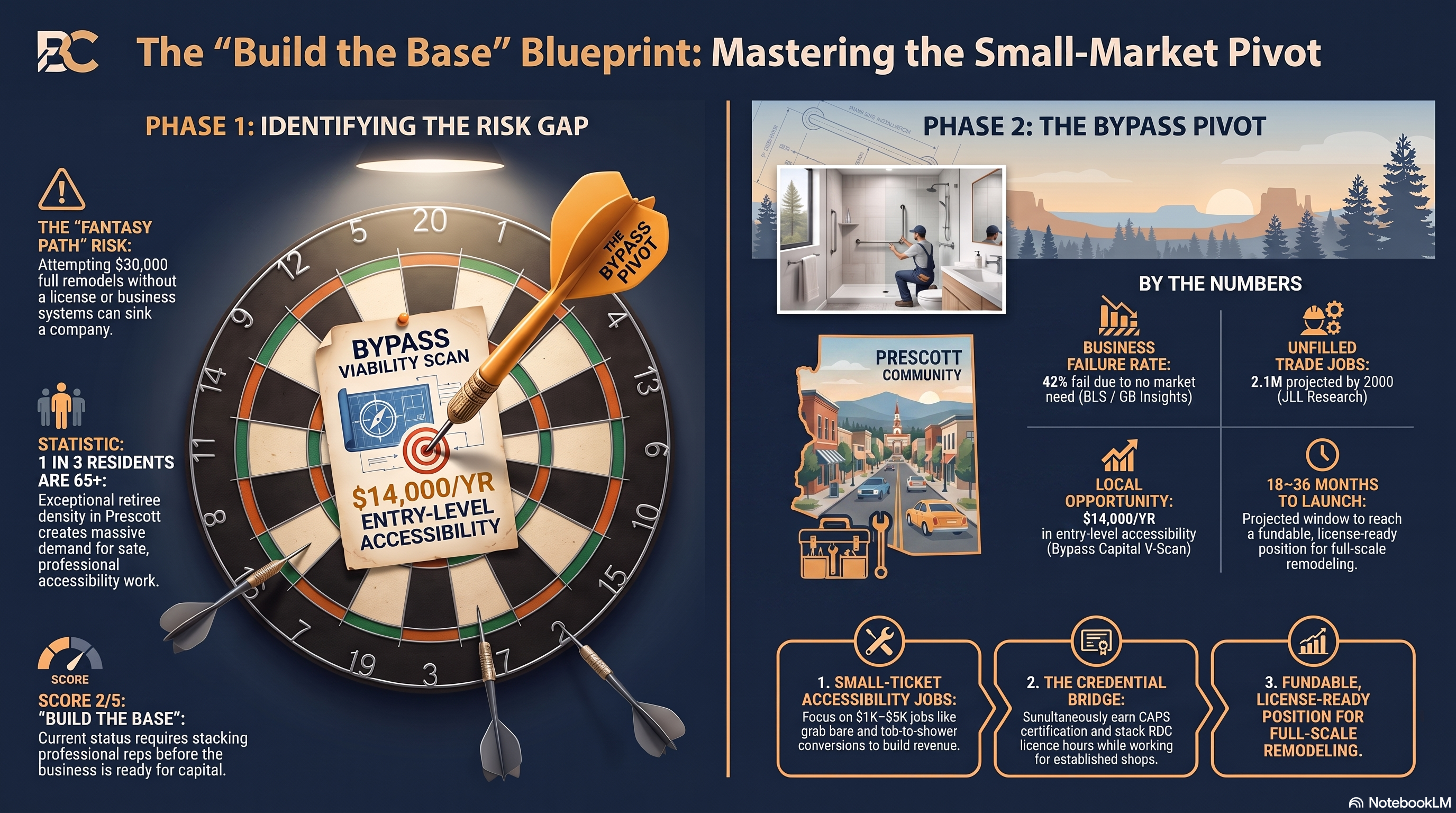
Imagine a landscape where demand is skyrocketing, competition is thin, and the local population is flush with the capital to pay for your services. In the remodeling world, this looks like a "green light" to quit the day job and launch. However, even in a gold-mine market, the most critical variable isn't the zip code—it’s the operator. The "Bypass Viability Gauge" often reveals a sobering reality: a market can be a 4 out of 5, while the business readiness is a 2. Moving before you’re ready isn’t an "entrepreneurial leap"; it’s a calculated way to end your career before it starts.
1. The Operator Is the Variable, Not the Market
It is a common misconception that a booming market automatically guarantees a successful business. In Yavapai County, the data is undeniably "outstanding." More than one-third of Prescott residents are 65 or older, making it one of the fastest-growing retirement destinations in the Southwest. However, a "2/5" viability score isn't an insult—it's a stage. If you had an operator like "Gloria" with 15 years of high-level experience, this market would be a 4/5. But if you’re at 1–2 years of part-time experience with a limited budget, the gap between your current skill set and the requirements of a full-scale aging-in-place business is massive. Pretending to be a full-scale operator prematurely is the fastest way to go broke on your first big job. "I'm going to give it to you straight, because a corner man who lies to his fighter gets him hurt: this is a 2 right now—and the 2 is about you, not the market."
2. The "Licensing Gate" is a Strategic Asset
In Arizona, the Registrar of Contractors (ROC) license acts as a mandatory barrier to entry. While this feels like a hurdle when you’re eager to launch, it is actually your greatest long-term protection. The licensing requirements ensure the competitive landscape remains "thin." Unlike the 200-deep "dogpile" you see in markets like Tampa, Prescott’s market is dominated by established, licensed specialists like Infinity Kitchens & Baths (who have been ROC-licensed and aging-in-place focused since 2011). These players set the standard. The licensing gate keeps out the "trunk-slammers" and protects the industry’s reputation. Earning the "reps" required to qualify for that license isn't a delay; it’s the seasoning you need to handle the liability of a $30,000 project.
3. The 80/20 Move: Think Small to Win Big
The most dangerous move you can make is the "Fantasy Path": attempting a full-scale solo remodel with only part-time experience and a few thousand dollars in the bank. Taking on a $30,000 bathroom you can't yet estimate or manage is the fastest way to blow the job, the money, and your local reputation in one shot. The 80/20 move is the Bypass Pivot . You focus on low-risk, high-demand accessibility jobs that fit your current skill and budget. This allows you to stack "full-time reps" and build documented revenue while the retiree demand continues to grow. The Base Path Actions:
● Target Government Funding: Focus on jobs funded by VA HISA grants (up to ~$6,800) and Medicaid-waiver dollars to ensure guaranteed payment.
● Low-Risk Accessibility: Focus on grab bars, comfort-height toilets, and tub-to-shower conversions.
● Professional Certification: Enroll in CAPS (Certified Aging-in-Place Specialist) training immediately to build credibility that doesn’t require 10 years of tenure.
● Banking ROC Hours: Land a spot with a quality licensed remodeler to accumulate the documented hours you need for your own license.
4. Reputation is a Double-Edged Sword in Small Markets
In a Tier 3 market like Prescott, word-of-mouth is your primary marketing engine. This is a gift and a curse. Customer acquisition costs are low because news of a reliable operator travels fast among retirees, but the stakes are unforgiving. In this demographic, "trust" is the only currency that matters. One "blown job" or code violation in a town where everyone knows everyone can sink your business before you’ve even printed your second batch of business cards. You don't build a reputation on a $30k dream job; you build it by being the most reliable person in the county for the $1,500 safety upgrade.
5. Real Financing is About "Fundability," Not Just Cash
A "good corner man" doesn't shove a fighter into the ring before they are ready, and a real lender won't fund a launch that is destined to fail. True "Funding Readiness" is built over a realistic 18–36 month timeline. This is the philosophy of Bypass Capital . While we offer higher approval rates and faster funding than traditional banks, we won't put capital behind an operator who hasn't built their base. You become fundable by showing a documented book of small jobs, an LLC in good standing, and progress toward your ROC license. Once that foundation is solid, Bypass Capital provides the startup-focused options and speed that banks won't touch. "A good corner man never shoves a fighter into the ring before he’s ready. Neither do we... build your base before the bell."
Conclusion: The Foundation for the Future
The 4-caliber market in Prescott is a genuine runway, and it isn't going anywhere. The retiree wave and the demand for safe, beautiful bathroom modifications will still be there in two years. Your only job right now is to ensure you are actually equipped to handle the flight. The question isn't whether the market is ready for you—it’s whether you are building a business on the shifting sands of "perfect demographics" or on a professional, licensed base. Are you lacing up for a fight you're destined to lose, or are you building the base that makes the win inevitable?
🛁 Bypass Viability Report — Sam · Bathroom Remodeling · Prescott, AZ
🟠 THE BYPASS VIABILITY GAUGE: 2 / 5 — "Build the Base"
📍 Territory Tier: Tier 3 — Small Market (Prescott / Yavapai County, AZ — 1/3 of residents 65+)
🚧 FOUNDATION FIRST: The market is excellent. You're not ready yet — and that's fixable. See The Bypass Pivot.
Section 1 — THE VERDICT
Sam, I'm going to give it to you straight, because a corner man who lies to his fighter gets him hurt: this is a 2 right now — and the 2 is about you, not the market. The market is outstanding. More than a third of Prescott residents are 65 or older, and Yavapai County is one of the fastest-growing retirement destinations in the Southwest (Infinity K&B, 2026). If you had Gloria's experience here, this would be a 4. But you're at 1–2 years, part-time, with a $1K–$5K budget — and your hurdle is the Business Side on top of a thin skill base. That's not a knock; it's a stage. You can't run a full aging-in-place remodeling business solo yet, and pretending otherwise is how new operators go broke on their first big job. The 2 means: the door is wide open, but you build the base first. Get there and this becomes one of the best small markets in the country for you.
Section 2 — THE LOCAL REALITY CHECK
The Competitive Landscape. Thin — and that's your long-term edge. Prescott has established, licensed specialists (Infinity Kitchens & Baths, ROC-licensed, aging-in-place focused since 2011), but nothing like the 200-deep Tampa dogpile. In a small market, one reliable, trustworthy operator becomes the referral over time — but "reliable and trustworthy" is earned with experience you're still building.
The Demand Signal. (1) Exceptional retiree density — 1/3 of Prescott 65+, and the fastest-growing buyer demographic is 55+ (local, Infinity K&B). (2) The safety driver — bathroom is the most dangerous room, and Arizona's large retiree base actively seeks walk-in showers, grab bars, and comfort-height fixtures (state, Lifetime Home, 2026). (3) Funding tailwinds for customers — VA HISA grants (up to ~$6,800) and Medicaid-waiver dollars help retirees pay (local, Infinity K&B).
The Big Guy Weakness. In a small market, the gap is simply capacity and trust — there aren't enough credible aging-in-place operators to serve the retiree wave. That gap is your opportunity, but it's a gap you fill by becoming credible, which takes reps.
Local Factors. Arizona requires an ROC license (with financial/experience requirements) — and at 1–2 years part-time, you likely don't qualify solo yet. That licensing gate is the honest, concrete reason the base has to come first.
Small Market Advantage (the payoff later). Once you have the reps and the license, Prescott's low customer-acquisition cost, fast word-of-mouth, and thin competition make it a genuine runway. The advantage is real — you just have to earn your way to it.
Section 3 — THE BYPASS PIVOT — The 80/20 Move
Sam, your pivot isn't a market change — it's a base-building sequence. At a 2, the honest 80/20 move is to close the experience-and-license gap while the retiree demand keeps growing, so you launch credible instead of crashing.
Positioning statement (where you're headed): "Prescott's trusted aging-in-place bathroom specialist — safe, beautiful, built to code."
The base-building math:
Fantasy path: launch a full solo remodeling business at 1–2 years part-time on $1K–$5K, take on a $30K bathroom you can't yet estimate or manage, and blow the job, the money, and your reputation in one shot.
Base path: (1) get on with a quality remodeler or CAPS-certified shop to stack full-time reps and hours toward your ROC license; (2) start CAPS certification now (it's knowledge, not tenure); (3) form your LLC and take on small, low-risk accessibility jobs — grab bars, comfort-height toilets, tub-to-shower conversions — that fit your skill and budget today and build documented revenue.
Fastest path to first revenue → scale: Your goal is a full-time aging-in-place business and your hurdle is the business side, so sequence it as a bridge: small accessibility jobs + reps + CAPS + license, then step into full remodels as the credibility and capital arrive.
The 80/20 truth: At your stage, 80% of your future success is decided by the base you build in the next 12–24 months — the license, the reps, the certification. Skip that 20% of foundation work and no market, however good, will save you.
Section 4 — FUNDING READINESS
Sam, picture how your morning really starts. You lace up your boots and step into a cage match — and right now you're stepping in as a lighter fighter than your opponents. In the other corners: ROC-licensed specialists like Infinity with 15 years in town, the Arizona licensing board itself standing between you and full jobs, retiree clients who need to trust an experienced hand, the estimating and business skills you're still building, and a banker looking at 1–2 years part-time and a $1K–$5K budget. That's a lot of weight to give away — and a good corner man doesn't send his fighter in over his head.
Every fighter who ever won under those lights had one thing in common: a corner man. Somebody who didn't throw the punches for him, but knew the fight, patched him up between rounds, and told him the truth about when to swing and when to wait. That's what Bypass Capital is — your corner man. And a good corner man never shoves a fighter into the ring before he's ready. Neither do we — and Sam, right now, the honest call is: build your base before the bell.
Here's the truth the way a real corner man would give it: at 1–2 years, part-time, with a $1K–$5K budget and no full ROC license yet, you're in the build-the-base band. That's not fundable for a full remodeling launch, and no honest lender would pretend it is — putting real capital behind you today would set you up to fail. What that budget does fund is your LLC, your CAPS enrollment, and small accessibility jobs that build documented revenue. Do that, stack your license hours, and you cross into fundable territory with a real foundation under you.
The Single Most Important Action: Get on with a quality/CAPS remodeler to stack full-time reps toward your ROC license, and start CAPS certification now — that's the base everything else is built on.
Realistic Timeline: ~18–36 months to a fundable, license-ready position — ROC hours accumulated, CAPS earned, LLC and a documented book of small accessibility jobs in place. Then the 4-caliber market is yours to take.
And here's the promise for when the bell actually rings, Sam. Bypass Capital works differently than a traditional lender — higher approval rates, days not months, paperwork that won't bury you, and startup-focused options a bank won't touch. When your base is built and you're truly ready, we're the corner that funds your real launch faster than any bank would allow. Not before you're ready — when you're ready.
Next step: When you're ready to step into your corner, it starts with a standard application — it tells us where you stand and what you need, so the conversation opens with real answers, not guesswork. Apply here: [APPLICATION LINK]
Section 5 — THE NEXT MOVE
The One Action (next 7 days): Land a full-time spot with a quality Prescott remodeler or CAPS shop to start banking ROC-license hours, and enroll in CAPS — that's your base, starting this week.
The 30-Day Marker: 30 days out you should have your LLC formed, CAPS in progress, and a plan to accumulate the license hours — plus maybe your first small grab-bar or comfort-height job booked through a business account.
The Honest Warning: Sam, the worst thing you could do is take a full $30K aging-in-place remodel before you're licensed and ready — one blown job in a small town where word travels fast can sink you before you start. Build the base, earn the trust, and this excellent market will still be here waiting for you.
Other note worthy case studies.
→A $31,000 remodel vs. $112,000 a year in nursing care — see the math behind Gloria's niche →
→How a Tampa remodeler turns occupational therapists into his best referral source →